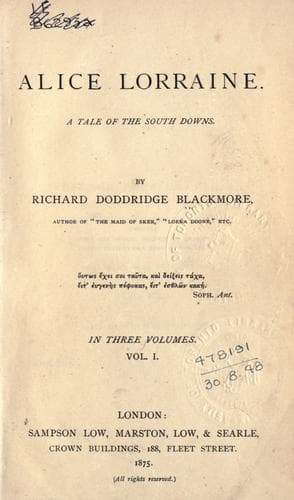
Alice Lorraine: A Tale of the South DownsBlackmore, R. D. (Richard Doddridge)
General
Alice Lorraine: A Tale of the South Downs
Blackmore, R. D. (Richard Doddridge)
Peninsular War, 1807-1814 -- Fiction; South Downs (England) -- Fiction
Sir Roland Lorraine was almost as free from superstition as need be. To
be wholly quit of that romantic element is a disadvantage still; and
excepts a neighbour even now from the general neighbourly sympathy.
Threescore years ago, of course, that prejudice was threefold.
The swing of British judgment mainly takes magnetic repulse from
whatever the French are rushing after. When they are Republican, all of
us rally for throne and Constitution. When they have a Parliament, we
want none. When they are pressed under empire, we are apt to be glad
that it serves them right. We know them to be brave and good, lovers of
honour, and sensitive; but we cannot get over the line between us and
them--and the rest of the world, perhaps.
Whatever might be said or reasoned, for or against the whole of
such things, Sir Roland had long made up his mind to be moderate
and neutral. He liked everybody to speak his best (according to
self-opinion), and he liked to keep out of the way of them all, and
relapse into the wiser ages. He claimed his own power to think for
himself, as well as the mere right of doing so. And therefore he long
had been “heterodox” to earnest, right-minded people.
Never the more, however, could he shake himself free from the inborn
might of hereditary impress. The traditions of his house and race had
still some power over him, a power increased by long seclusion, and the
love of hearth and home. Therefore, when Trotman was cut off, on his
way for his weekly paper, by a great black gliding flood, and aghast
ran up the Coombe to tell it--Sir Roland, while he smiled, felt strange
misgivings creeping coldly.
Alice, a sweet and noble maiden, on the tender verge of womanhood, came
to her father’s side, and led him back to his favourite book-room. She
saw that he was at the point of trembling; although he could still
command his nerves, unless he began to think of them. Dissembling her
sense of all this, she sat by the fire, and waited for him.
“My darling, we have had a very happy time,” he began at last to say to
her; “you and I, for many years, suiting one another.”
“To be sure we have, father. And I mean to go on suiting you, for many
more years yet.”
Her father saw by the firelight the sadness in her eyes; and he put
some gaiety into his own, or tried.
“Lallie, you have brighter things before you--a house of your own, and
society, and the grand world, and great shining.”
“Excellent things, no doubt, my father; but not to be compared with you
and home. Have I done anything to vex you that you talk like this to
me?”
“Let me see. Come here and show me. There are few things I enjoy so
much as being vexed by you.”
“There, papa, you are in a hurry to have your usual laugh at me. You
shall have no material now. ‘I knows what is right, and I means to do
it’--as the man said to me at the turnpike-gate, when he made me pay
twice over. Consider yourself, my darling father, saddled for all your
life with me.”
Public-domain text, read in full here on John Shaqi.
Reviews
Reviews
No reviews yet
Be the first to share your thoughts on this work.
Elsewhere in the archive
Join the Discussion
Join the discussion
Sign in to leave a comment or review.
Sign InorCreate an account