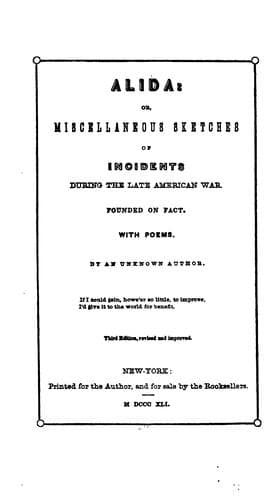
Alida; or, Miscellaneous Sketches of Incidents During the Late American War.: Founded on FactComfield, Amelia Stratton
History
Alida; or, Miscellaneous Sketches of Incidents During the Late American War.: Founded on Fact
Comfield, Amelia Stratton
United States -- History -- Revolution, 1775-1783 -- Juvenile fiction
Theodore stated these facts to his friends; told them that on every
occasion he should be ready to fly to the post of danger when his
country was invaded, and that as soon as his father's affairs became
settled, he would, if necessary, join the army.
The president was now active in making every exertion in his power, to
rouse the feelings of his countrymen to act their parts with honour in
the scene that was now before them. He knew that much of the
responsibility rested on himself. The capacity he was in with regard to
the nation, caused the most material and important business--of
directing and superintending the weighty affairs of government--to fall
upon his hands; and such was the situation of the country, that it not
only called for the exertion, the wisdom, sound judgment, and policy of
the presidential chair, but likewise of every patriotic bosom to
participate in their endeavours to oppose the depredations against it.
The chief executive was entered on a theatre in which he was to act a
conspicuous part in this war of America with Great Britain, and to
occupy a station in the page of history, where the interesting detail
will reach the ear of remotest ages in the dates of time.
In the mean time, the father of Theodore had been absent for three or
four days to one of the commercial seaports, on business with some
merchants with whom he was connected in trade. He returned the next day
after Theodore had got home; his aspect and his conversation were marked
with an assumed and unmeaning cheerfulness. At supper he ate nothing,
discoursed much, but in an unconnected and hurried manner, interrupted
by long pauses, in which he appeared to be buried in contemplation.
After supper he asked Theodore "if it were not possible that his union
with Alida could be concluded within a few days?" Theodore, startled at
so unexpected a question, replied, that such a proposal would be
considered extraordinary, perhaps improper; besides, when Alida had
named the day, she mentioned that she had an uncle who lived at a
distance, whose daughter was to pass the summer with her, and was
expected to arrive before the appointed time. It would, he said, be a
delicate thing for him to anticipate the nuptials, unless he could give
some cogent reason for so doing, and at present he was not apprised that
any such existed. His father, after a few moments' hesitation, answered,
"I have reasons which, when told,"--here he stopped, suddenly arose,
hastily walked the room in much visible agony of mind, and then retired
to his chamber.
Public-domain text, read in full here on John Shaqi.
Reviews
Reviews
No reviews yet
Be the first to share your thoughts on this work.
Join the Discussion
Join the discussion
Sign in to leave a comment or review.
Sign InorCreate an account