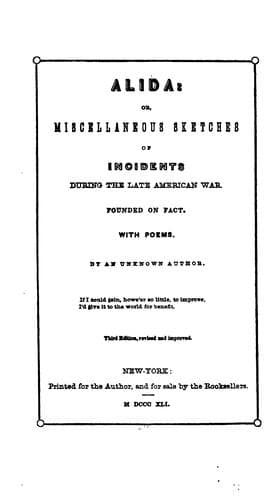
Alida; or, Miscellaneous Sketches of Incidents During the Late American War.: Founded on Fact — John Shaqi
Alida; or, Miscellaneous Sketches of Incidents During the Late American War.: Founded on FactComfield, Amelia Stratton
History
Alida; or, Miscellaneous Sketches of Incidents During the Late American War.: Founded on Fact
Comfield, Amelia Stratton
United States -- History -- Revolution, 1775-1783 -- Juvenile fiction
Alida now returned home, attended by Theodore. A whip-poor-will tuned
its nightly song at a distance; but the sound which had so late appeared
to them cheerful and sprightly, now passed heavily over their hearts.
CHAPTER XII.
"O, happiness, deceitful in thy dream,"
Though wreaths all blooming hang upon thy brow,
And quick dissolves the visionary gleam,
Succeeded soon by various scenes of wo.
When Theodore returned to the house of his friend, he unfolded the plan
he had projected.
"No sooner," said Raymond, "was I informed of your misfortunes, than I
was convinced that Alida's father (whom I have known for many years)
would endeavour to dissolve your intended union with his daughter. And
however he may doat on his children, or value their happiness, he will
not hesitate to sacrifice his better feelings to the accomplishment of
his wishes to see them independent. It appears that you have but one
resource left. You and Alida are now engaged by the most solemn ties, by
every rite except those which are ceremonial; these I would advise you
to enter into, and trust to the consequences. Mrs. Raymond has proposed
the scheme to Alida, but implicitly accustomed to filial obedience, she
shudders at the idea of a clandestine marriage; but when her father will
proceed to rigorous measures, she will, I think, consent to the
alternative. The world is before you, Theodore," continued he; "you have
friends, you have acquirements which will not fail you. In a country
like this you can scarcely help obtaining a competency, which, with the
other requisites you have in your power, will not fail to insure your
independence and felicity."
"But the times have changed," said Theodore, since the commencement of
the war, and probably I may yet have to join the army. After I have made
my visit on the morrow to Alida's father, we will discourse further on
the subject.
In the meantime, Theodore proceeded on the morrow, to make his intended
visit. As he approached the house, he saw Alida sitting in a shady
recess at one end of the garden, near which the road passed. She was
leaning with her head upon her hand in a pensive posture; a deep
dejection was depicted upon her features, which enlivened into a
transient glow as soon as she saw Theodore. She arose, met him, and
invited him into the house.
Theodore was received with a cool reserve by all except Alida. Her
father saluted him with a distant retiring bow, as he passed with her to
the parlour. As soon as they were seated, a lady who had lately come to
reside some time in the family, (who was a relative of her father's,)
entered the room and seated herself by the window, alternately humming a
tune and staring at Theodore, without speaking a word.
This interruption was not of long continuance. Alida's father entered,
and requested the two ladies to withdraw, which was instantly done; he
then addressed Theodore as follows:
Public-domain text, read in full here on John Shaqi.
Reviews
Reviews
No reviews yet
Be the first to share your thoughts on this work.
Join the Discussion
Join the discussion
Sign in to leave a comment or review.
Sign InorCreate an account