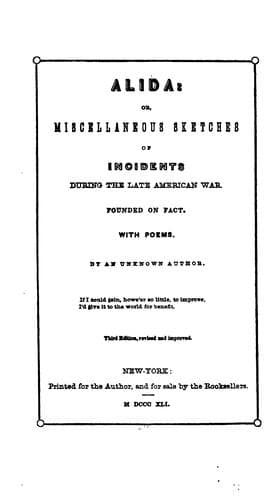
Alida; or, Miscellaneous Sketches of Incidents During the Late American War.: Founded on FactComfield, Amelia Stratton
History
Alida; or, Miscellaneous Sketches of Incidents During the Late American War.: Founded on Fact
Comfield, Amelia Stratton
United States -- History -- Revolution, 1775-1783 -- Juvenile fiction
A sorrow unknown before seized upon the minds of his parents as Theodore
repeated these words. Sad and dreadful ideas crowded their imagination
at this gloomy period, when in the war's dread emergency they must risk
the life of an only son, to march to the field of battle. 'Tis true, he
might be again restored to them, but were there not a thousand chances
to one? They were overwhelmed with sorrow at these thoughts, till at
length they finally felt themselves obliged to consent to what they
considered his inevitable destiny, leaving the result of their united
wishes and prayers for his safe preservation to an over-ruling
Providence.
His father then offered him money he had on hand to defray his expenses.
Theodore refused, saying, his resources had not yet left him. He then
disposed of his horses and carriages, the insignia of his better days,
but now useless appendages.
After taking an affectionate leave of his parents, he set out the
ensuing day to join his companions on their route to meet the army,
which was far distant. When hostilities first commenced, Theodore had
said, that when it became actually necessary, and his father's affairs
were settled, he would enlist in the service of his country.
Nevertheless, he journeyed with a heavy heart and an enfeebled frame of
spirits, through disappointment, vexation, and fatigue. The scenes he
had so lately experienced moved in melancholy succession over his mind,
and his despondency had not abated, even in a small degree, when he
reached the army.
He now joined the forces under Colonel Van Renssalaer, "who, with a
detachment of about one thousand men, crossed the river Niagara, and
attacked the British on Queenstown heights. This detachment succeeded in
dislodging the enemy, but not being reinforced by the militia from the
American side, as was expected, they were ultimately repulsed, and
obliged to surrender. Eight hundred British soldiers now came to the aid
of the others, and pressed on to renew the attack. The Americans for a
time continued to struggle against this force, but were finally obliged
to surrender themselves prisoners of war."
The fate of war was hard for Theodore, on his first expedition. He was
taken, and carried among the rest on board a prison-ship, and sent with
a number of others to England.
This disastrous event, however, was shortly followed by one more
fortunate for the Americans. "General Dearborn embarked at Sackett's
Harbour, with sixteen hundred men, on an expedition against York, and
succeeded in the capture of that place.
"York was the seat of government for Upper Canada, and the principal
depot for the Niagara frontier. More naval stores were taken by the
Americans than could be carried away. The government hall was burned,
contrary to the orders of the American general."
CHAPTER XIV.
Public-domain text, read in full here on John Shaqi.
Reviews
Reviews
No reviews yet
Be the first to share your thoughts on this work.
Join the Discussion
Join the discussion
Sign in to leave a comment or review.
Sign InorCreate an account