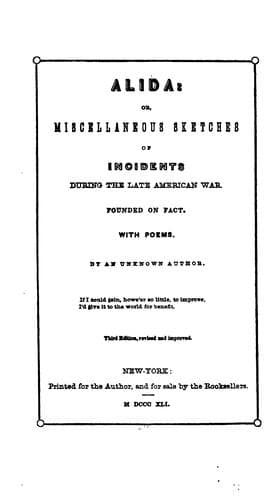
Alida; or, Miscellaneous Sketches of Incidents During the Late American War.: Founded on FactComfield, Amelia Stratton
History
Alida; or, Miscellaneous Sketches of Incidents During the Late American War.: Founded on Fact
Comfield, Amelia Stratton
United States -- History -- Revolution, 1775-1783 -- Juvenile fiction
Many heroes ventured forth to the field of battle, with the ardent
endeavour, still to preserve their independence; while at the same time
the hearts of many were failing them with fear. It was a time for the
patriot to use his influence to animate others anew to bravery, and
persuade them to be zealous, in a just cause; at this season of general
excitement, in which the feelings of the whole community had become
strongly interested. Party spirit, and the conflicting interests of the
different states were found to operate injuriously on many in their
commercial transactions. The people were impoverished by the expenses of
the war. Some were in debt. Creditors resorted to legal measures to
enforce a collection of their demands, which involved many families in
deep embarrassment. Peace was sighed for by the multitude, but there
were yet no signs of its realization. An engagement had just taken place
on Lake Erie. The American fleet was commanded by Commodore Perry,
a young officer; that of the British under Com. Barclay, an old and
experienced officer, who had served under Nelson. After a contest of
three hours the Americans gained a complete victory, and captured every
vessel of the enemy. Commodore Perry announced this victory in the
following laconic style: "We have met the enemy, and they are ours." The
Americans took six hundred prisoners, which exceeded their whole number
engaged in the action. This battle was succeeded, several weeks
afterwards, by another that was alike fortunate, between the American
army under General Harrison, and the British under Gen. Proctor, in
which they were defeated, and Detroit fell into the hands of the
Americans. The success of this action may be entirely attributed, (under
the favour of heaven,) to the abilities and military skill of General
Harrison.
After General Hull had tamely surrendered to the British this important
post, with the gallant force that composed the garrison, an event which
spread consternation far and wide throughout the western country, and
greatly increased the difficulty and arduous nature of Gen. Harrison's
duties, he immediately organized the brave troops under his command, and
commenced a course of rigid discipline, and military trainings, with the
confident hope of retrieving the consequent disasters of this
proceeding.
Public-domain text, read in full here on John Shaqi.
Reviews
Reviews
No reviews yet
Be the first to share your thoughts on this work.
Join the Discussion
Join the discussion
Sign in to leave a comment or review.
Sign InorCreate an account