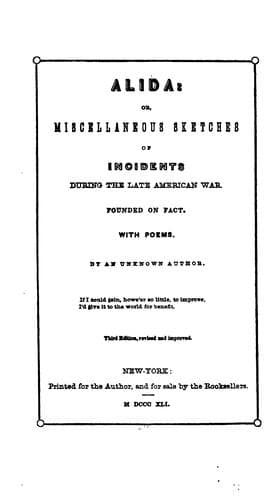
Alida; or, Miscellaneous Sketches of Incidents During the Late American War.: Founded on FactComfield, Amelia Stratton
History
Alida; or, Miscellaneous Sketches of Incidents During the Late American War.: Founded on Fact
Comfield, Amelia Stratton
United States -- History -- Revolution, 1775-1783 -- Juvenile fiction
Albert had been extremely busy through the day, and was just returning
home from his store in Pearl-street one evening, when he met Bonville in
Broadway on his way to his father's. He accosted him in a very friendly
manner, and then interrogated him by numerous questions concerning the
family,--and very inquisitively with regard to his sister. Albert made
no reply that gave him any particular satisfaction. When they arrived at
the house, they found no company except Mr. More. Alida was truly
shocked and surprised at this unexpected visit from Bonville, who she
had no idea was in town. After making to her his compliments, and
expressing his pleasure at finding her well, he by degrees drew her into
a conversation which lasted the greater part of the evening. He offered
an ill-timed consolation for the absence of Theodore, and affected much
regret,--although he said his case was not as deplorable as that of many
others, as he was still among the living. That though he was a person he
could not esteem, still he had felt so far interested in his welfare, as
to make particular inquiries how the British were accustomed to treat
their prisoners. He then gave some dark intimations against his general
character, which could not fail to throw over the mind of Alida a deep
dejection.
She was now apprised of the fate of Theodore:--She was unable to
suppress the feelings of sorrow, that these words of Bonville had
excited. She remained silent; wholly engrossed by the confused thoughts
and sad ideas, that arose in succession in her mind, till at length she
became regardless of all around her.
The penetrating eyes of Mr. More were fixed upon her during this
conversation. He seemed wholly insensible to every other object. He was
apprehensive that her heart was insensible to the strong affection that
pervaded his own,--and he thought should she prove incapable of loving
like himself, and should become devoted to another, thoughts he could
scarcely endure,--though they sometimes impressed the idea that she
might never be interested in his favour. Hope would again flatter him
with the pleasing thought, that her bosom may have been fraught with
congenial feelings, and her heart beat with sensations even more fervent
than his own. Her image filled his waking thoughts, and disturbed with
visionary happiness his sleeping hours,--yet it seemed to his devoted
mind the love of merit alone; and he imagined that while she was happy,
he could never be altogether otherwise.
Public-domain text, read in full here on John Shaqi.
Reviews
Reviews
No reviews yet
Be the first to share your thoughts on this work.
Join the Discussion
Join the discussion
Sign in to leave a comment or review.
Sign InorCreate an account