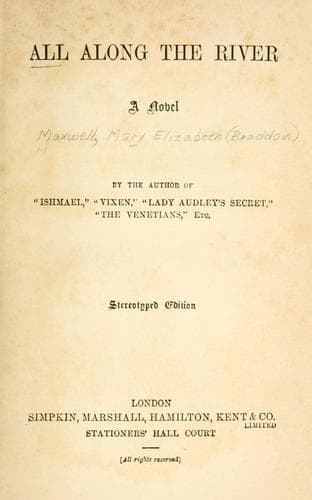
All along the River: A NovelBraddon, M. E. (Mary Elizabeth)
General
All along the River: A Novel
Braddon, M. E. (Mary Elizabeth)
English fiction -- 19th century
She went about her day’s varied work as usual--curious to see the new
acquaintance--yet in no wise excited. Vivid and animated, enthusiastic
and energetic as she was in all her thoughts and ways, gushing
sentimentality made no part of Miss Leland’s character. Life at
Trelasco flowed with such an even monotony, there was such a dearth of
new interests, that it was only natural that a girl of vivacious temper
should be curious about new-comers. At St. John’s Wood every day had
brought some new element into the lives of the students, and almost
every day had brought a new pupil, drawn thither by the growing renown
of the school, pupils from the uttermost ends of the earth sometimes,
pupils of swart complexion speaking unknown tongues, pupils patrician
and pupils plebeian, each and all conforming to the same stringent
rules of art, spending patient months in the shading of a brace of
plums or a bunch of grapes, from a plaster cast, and toiling slowly up
the gradual ascent which leads to the Royal Academy and the gold medal.
Many there were who sickened at the slow rate of progress and who fell
away. Only the faithful remained. And this going and coming, this
strife between faith and unfaith, patience and impatience, had made
a perpetual movement in the life of the great school--to say nothing
of such bodily activities as lawn tennis, for which the master had
provided a court--a court for his girl-pupils, be it noted, where they
played among themselves, as if they had been so many collegians in the
college of Tennyson’s “Princess.”
Allegra had liked her life at the great art school, but she had never
regretted its abandonment. She loved her brother, and her brother’s
wife, better even than she loved art. It was only now and then that she
felt that existence at Trelasco was as monotonous as the flow of the
river going up and coming down day by day between Lostwithiel and the
sea.
She spent the hours between breakfast and luncheon hard at work in her
painting-room--a little room with a large window facing northward. She
had the coachman’s girl and boy for her models, and was engaged upon
a little water-colour picture after the school of Mrs. Allingham, a
little picture which told its story with touching simplicity.
It was not the first picture of the kind she had painted. Several
of her works had been exhibited at the minor galleries which are
hospitable to the new-comer in the world of art; and two small pictures
had been bought at prices which seemed to promise her an easy road to
fortune.
Public-domain text, read in full here on John Shaqi.
Reviews
Reviews
No reviews yet
Be the first to share your thoughts on this work.
Elsewhere in the archive
Join the Discussion
Join the discussion
Sign in to leave a comment or review.
Sign InorCreate an account