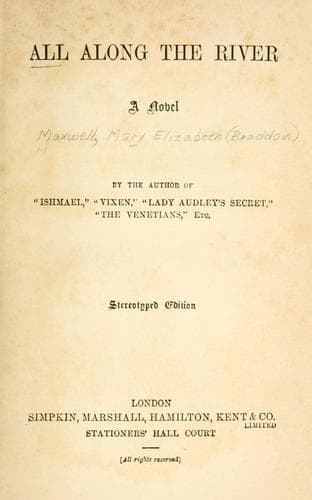
All along the River: A NovelBraddon, M. E. (Mary Elizabeth)
General
All along the River: A Novel
Braddon, M. E. (Mary Elizabeth)
English fiction -- 19th century
The coachman’s children profited greatly by this new profession which
had been devised for them. Allegra made their frocks in her leisure
hours, when the active fingers must have something to do, while the
active tongue ran on gaily in happy talk with Martin and Isola. Allegra
made up to her little models for their hours of enforced idleness by
extra tuition which kept them ahead of most of the other pupils in the
village school; and Allegra supplied them with pocket-money.
“I don’t know however the children got on before Miss Leland came,”
said the coachman’s wife. “They seem to look to her for everything.”
Allegra had other models, village children, and village girls--her
beauty-girl, a baker’s daughter with a splendid semi-Greek face,
like Mrs. Langtry’s, whom she dressed up in certain cast-off finery
of her own, and painted in her genre pictures, now in this attitude,
and now in that, imparting an air of distinction which elevated the
Cornish peasant into a patrician. She it was, this baker’s fair-haired
daughter, who stood for Allegra’s successful picture--“A daughter of
the gods, divinely tall,” a little bit of finished painting which had
brought the painter five and thirty guineas--boundless wealth as it
seemed to her--and ever so many commissions.
Art, even in despondency and failure, is a consolation; art successful
is an intoxicating delight. Allegra was as happy a young woman as could
be found in Cornwall that day, when she shut her colour-box, dismissed
her little maiden, and ran down to lunch, where she found Isola more
silent than usual, and made amends by her own light-hearted chatter
for the morning’s absorption over the easel. After lunch she ran off
to the village to pay her parish visits to the sick and old, and on
her way to an outlying cottage she met Mr. Colfox, who immediately
turned to accompany her, a way he had, but a way to which she had never
attached any significance. He was a clever, well-read man, of somewhat
original temper, who had to pass most of his life among unlettered or
dull people; therefore it surprised Allegra in no wise that he should
like to talk to her. A bright, attractive girl of three and twenty is
very unsuspicious about the feelings of a homely looking man at least a
dozen years her senior.
“Your brother has been good enough to ask me to dinner,” he said, after
a little talk about the Goodies and their ailments. “I met him at the
club this morning.”
“He wants you to meet Captain Hulbert. Perhaps you know him already?”
“No, he has not been here within my time. He only left the navy a year
ago, and he was generally stationed at the utmost ends of the earth,
keeping guard over our remote possessions. Have you seen him?”
“Only for an instant. He passed my sister and me yesterday evening in
the moonlight. I thought he looked a nice person--but I think women
have a natural leaning towards sailors. I could never imagine a seaman
telling a falsehood or doing a mean action.”
Public-domain text, read in full here on John Shaqi.
Reviews
Reviews
No reviews yet
Be the first to share your thoughts on this work.
Elsewhere in the archive
Join the Discussion
Join the discussion
Sign in to leave a comment or review.
Sign InorCreate an account