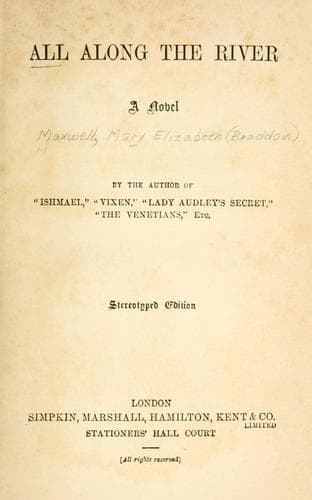
All along the River: A NovelBraddon, M. E. (Mary Elizabeth)
General
All along the River: A Novel
Braddon, M. E. (Mary Elizabeth)
English fiction -- 19th century
“No, no, no, my dear. The home is safe enough; the house will stand
firm as long as you and I live. I am not a shilling poorer than I was
yesterday. There is nothing the matter--nothing worth speaking about;
blue devils, vapours if you like. That’s all.”
“You are ill, Martin. You have found out that there is something wrong
with you--heart, lungs, something--and you are going to London to
consult a physician. Oh, my dear, dear brother,” she cried, with a look
of agony, her arms still clasped about his neck, “don’t keep me in the
dark; let me know the worst.”
“There is no worst, Allegra. I am out of sorts, that’s all. I am going
to town to see my lawyer.”
CHAPTER XV.
“MY LIFE CONTINUES YOURS, AND YOUR LIFE MINE.”
They started by the eleven-o’clock train from Fowey next morning,
husband and wife, in a strangely silent companionship--Isola very pale
and still as she sat in a corner of the railway carriage, with her back
to the rivers and the sea. Naturally, in a place of that kind, they
could not get away without being seen by some of their neighbours.
Captain Pentreath was going to Bodmin, and insisted upon throwing away
a half-finished cigar in order to enjoy the privilege of Colonel and
Mrs. Disney’s society, being one of those unmeditative animals who
hate solitude. He talked all the way to Par, lit a fresh cigar during
the wait at the junction, and reappeared just as the colonel and his
wife were taking their seats in the up-train.
“Have you room for me in there?” he asked, sacrificing more than
half of his second cigar. “I’ve got the _Mercury_--Jepps is in for
Stokumpton--a great triumph for our side.”
He spread out the paper, and made believe to begin to read with a great
show of application, as if he meant to devour every syllable of Jepps’s
long exposition of the political situation; but after two minutes he
dropped the _Mercury_ on his knees and began to talk. There were people
in Fowey who doubted whether Captain Pentreath could read. He had been
able once, of course, or he could hardly have squeezed himself into the
Army; but there was an idea that he had forgotten the accomplishment,
except in its most elementary form upon sign-boards, and in the
headings of newspaper articles, printed large. It was supposed that the
intensity of effort by which he had taken in the cramming that enabled
him to pass the ordeal of the Examiners had left his brain a blank.
“You’re not going further than Plymouth, I suppose?” he asked.
“We are going to London.”
“Are you really, now? A bad time of year for London--fogs and thaws,
and all kinds of beastly weather.”
And then he asked a string of questions--futile, trivial, vexing as
summer flies buzzing round the head of an afternoon sleeper; and then
came the welcome cry of Bodmin Road, and he reluctantly left them.
Public-domain text, read in full here on John Shaqi.
Reviews
Reviews
No reviews yet
Be the first to share your thoughts on this work.
Elsewhere in the archive
Join the Discussion
Join the discussion
Sign in to leave a comment or review.
Sign InorCreate an account