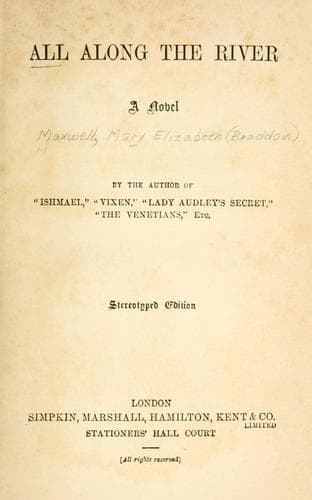
All along the River: A NovelBraddon, M. E. (Mary Elizabeth)
General
All along the River: A Novel
Braddon, M. E. (Mary Elizabeth)
English fiction -- 19th century
The rest of the journey was passed almost in silence. They had the
compartment to themselves for the greater part of the time, and they
sat in opposite corners, pretending to read--Isola apparently absorbed
in a book that she had taken up at random just before she started, when
the carriage was at the door, and while Allegra was calling to her to
make haste.
It was Carlyle’s “Hero Worship.” The big words, the magnificent
sentences, passed before her eyes like lines in an unknown language.
She had not the faintest idea what she was reading; but she followed
the lines and turned the leaf at the bottom of a page mechanically.
Martin Disney applied himself to the newspapers which he had
accumulated on the way--some at Par, some at Plymouth, some at Exeter,
till the compartment was littered all over with them. He turned and
tossed them about one after the other. Never had they seemed so
empty--the leaders such mere beating the air; the hard facts so few and
insignificant. He glanced at Isola as she sat in her corner, motionless
and composed. He watched the slender, white hands turning the leaves of
her book at regular intervals.
“Is your book very interesting?” he asked, at last, exasperated by her
calmness.
He had been attentive and polite to her, offering her the papers,
ordering tea for her at Exeter, doing all that a courteous husband
ought to do; but he had made no attempt at conversation--nor had she.
This question about the book was wrung from him by the intensity of his
irritation.
“It is a book you gave me years ago at Dinan,” she answered, looking at
him piteously. “‘Hero Worship.’ Don’t you remember? I had never read
anything of Carlyle’s before then. You taught me to like him.”
“Did I? Yes, I remember--a little Tauchnitz volume bound in
morocco--contraband in England. A cheat--like many things in this life.”
He turned his face resolutely to the window, as if to end the
conversation, and he did not speak again till they were moving slowly
into the great station, in the azure brightness of the electric light.
“I have telegraphed for rooms at Whitley’s,” he said, naming a small
private hotel near Cavendish Square, where they had stayed for a few
days before he started for the East.
“Do you think it would be too late for us to call at Hans Place before
we go to our hotel?”
She started at the question. He saw her cheeks crimson in the lamplight.
“I don’t think the lateness of hour will matter,” she said, “unless
Gwendolen is dining out. She dines out very often.”
“I hope to-night may be an exception.”
“Do you want very much to see her?” asked Isola.
“Very much.”
“You are going to question her about me, I suppose?”
“Yes, Isola, that is what I am going to do.”
“It is treating me rather like a criminal; or, at any rate, like a
person whose word cannot be believed.”
Public-domain text, read in full here on John Shaqi.
Reviews
Reviews
No reviews yet
Be the first to share your thoughts on this work.
Elsewhere in the archive
Join the Discussion
Join the discussion
Sign in to leave a comment or review.
Sign InorCreate an account