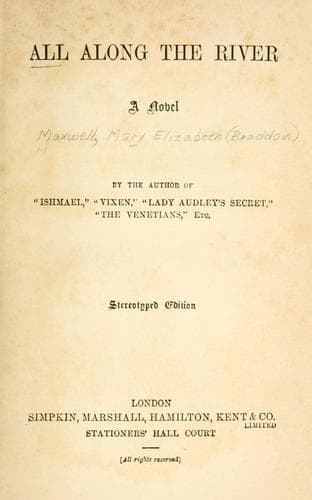
All along the River: A NovelBraddon, M. E. (Mary Elizabeth)
General
All along the River: A Novel
Braddon, M. E. (Mary Elizabeth)
English fiction -- 19th century
Mr. Baynham had a serious talk with the colonel after he left Isola,
and it was agreed between them that she should be taken to Plymouth
next day to see the great authority.
“You are giving yourself a great deal too much trouble about me,
Martin,” she said. “There is nothing wrong. I am only a little weak and
tired sometimes.”
Her husband looked at her heart-brokenly. Weak and tired. Yes; there
were all the signs of failing life in those languid movements of
the long, slender limbs, in the transparent pallor of the ethereal
countenance. Decay was lovely in this fair young form; but he felt
that it was decay. There must be something done to stop Misfortune’s
hastening feet.
He questioned his wife, he questioned his own memory, as to when the
change had begun, and on looking back thus thoughtfully it seemed to
him that her spirits and her strength had flagged from the time of
Captain Hulbert’s arrival at Fowey. She had seemed tolerably cheerful
until then, interested in life, ready to participate in any amusement
or occupation of Allegra’s; but from the beginning of their yachting
excursions there had been a change. She had shrunk from any share in
their plans or expeditions. She had gone on board the yacht--on the
two or three occasions when she had been persuaded to go--with obvious
reluctance, and she had been silent and joyless all the time she was
there. Within the last fortnight, when Captain Hulbert had pressed her
to go to luncheon or afternoon tea at the Mount, she had persistently
refused. She had begged her husband to take Allegra, and to excuse her.
“The walk up the hill would tire me,” she said.
“My love, why should we walk? I will drive you there, of course.”
“I really had rather not go. I can’t bear leaving baby so long; and
there is no necessity for me to be with you. Allegra is the person
who is wanted. You must understand that, Martin. You can see how much
Captain Hulbert admires her.”
“And I am to go and play propriety while you do baby-worship at home.
Rather hard upon me.”
This kind of thing had occurred three or four times since the
sailor’s establishment at the Mount, and Colonel Disney had attached
no significance to the matter; but now that he had begun to torture
himself by unending speculations upon the cause of her declining
health, he could but think that Captain Hulbert’s society had been
distasteful to her. It might be that Mr. Crowther’s insulting allusions
to Lord Lostwithiel had made any association with that name painful;
and yet this would seem an overstrained sensitiveness, since her own
innocence of all evil should have made her indifferent to a vulgarian’s
covert sneers.
CHAPTER XVII.
“THE YEAR OF THE ROSE IS BRIEF.”
Public-domain text, read in full here on John Shaqi.
Reviews
Reviews
No reviews yet
Be the first to share your thoughts on this work.
Elsewhere in the archive
Join the Discussion
Join the discussion
Sign in to leave a comment or review.
Sign InorCreate an account