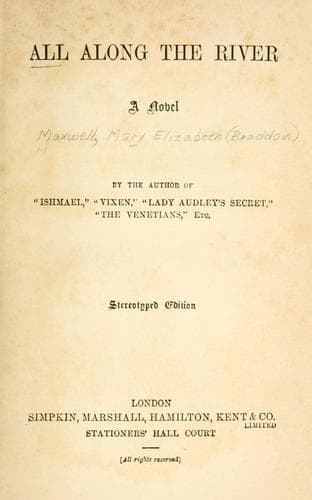
All along the River: A NovelBraddon, M. E. (Mary Elizabeth)
General
All along the River: A Novel
Braddon, M. E. (Mary Elizabeth)
English fiction -- 19th century
Mr. Baynham accompanied his patient and her husband to Plymouth,
where the family adviser of Trelasco had a long and serious talk with
the leading medical light of the great seaport. The result of which
consultation--after the tossing to and fro of such words as anæmia,
atrophy, family history, hysteria, between the two doctors, as lightly
as if diseases were shuttle-cocks--was briefly communicated to Colonel
Disney in a sentence that struck terror to his heart, carefully as it
was couched. It amounted in plain words to this: We think your wife’s
condition serious enough to cause alarm, although there are at present
no indications of organic disease. Should her state of bodily weakness
and mental depression continue, we apprehend atrophy, or perhaps
chronic hysteria. Under these circumstances, we strongly recommend you
to give her a change of scene, and a milder winter climate even than
that of the west of England. Were she living in Scotland or Yorkshire
we might send her to Penzance; but as it is we should advise either a
sea voyage, or a residence for the rest of the winter at Pau, Biarritz,
or on the Riviera.
Modern medicine has a high-handed way of sending patients to the
uttermost ends of the earth; and although Martin Disney thought with
a regretful pang of the house and stables that he had built and
beautified for himself, the garden where every shrub was dear, yet he
felt grateful to the specialist for not ordering him to take his wife
to the banks of the Amazon or to some sheltered valley in Cashmere.
Pau is not far--the Riviera is the beaten track of civilized Europe,
the highway road to Naples and the East. He thought of the happy
honeymoon, when he and his bright young wife had travelled along that
garden of oranges and lemons, between the hills and the sea, and how
there had been no shadow on their lives except the shadow of impending
separation, about which they had talked hopefully, trying to believe
that a year or two would not seem very long, trying to project their
thoughts into that happy future when there should be no more parting.
This--this dreary present--was that future which they had pictured as a
period of unalloyed bliss. What had the future brought to that hopeful
husband, going forth at the call of duty, to return with fondest
expectations when his work was done? What but a year and a half of
wedded life overshadowed by disappointment, darkened by vague doubts?
And now came the fear of a longer parting than had lain at the end of
his last Italian journey.
The patient herself was told nothing except that change to a warmer
climate would be good for her, and that her husband had promised to
take her to the South soon after Christmas.
“You will like to go, won’t you, Isola?” he asked her tenderly, as
they drove back to the station alone, leaving Mr. Baynham to follow
his own devices in the town. “You will enjoy seeing the places we saw
together when our marriage was still a new thing?”
Public-domain text, read in full here on John Shaqi.
Reviews
Reviews
No reviews yet
Be the first to share your thoughts on this work.
Elsewhere in the archive
Join the Discussion
Join the discussion
Sign in to leave a comment or review.
Sign InorCreate an account