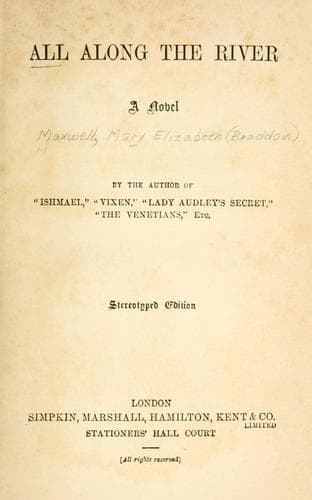
All along the River: A NovelBraddon, M. E. (Mary Elizabeth)
General
All along the River: A Novel
Braddon, M. E. (Mary Elizabeth)
English fiction -- 19th century
“Not such a girl as Allegra. She is always well dressed, and her
wardrobe is the perfection of neatness--but she is not the kind of girl
to make a fuss about her clothes. I don’t think the trousseau will
create any difficulty.”
“And when she is gone, what will you do without your devoted companion?
Who will nurse you and take care of you?”
“Löttchen, or any other servant,” she answered, with a kind of weary
indifference. “It would be very hard if my bad health should stand in
the way of Allegra’s happiness. So long as you will stay with me and be
kind to me, Martin, I need no one else.”
Tears were streaming down her cheeks as she turned from him, pretending
to be interested in the convent walls on the edge of the hill below
which they were driving.
“So long as I stay with you! My darling, do you think business or
pleasure, or any claim in this world, will ever take me from you any
more? All your hours are precious to me, Isola. I hardly live when I am
away from you. Wherever your doctor may send you, or your own fancy may
lead you, I shall go with you, unhesitatingly--without one regret for
anything I leave behind.”
“Don’t say these things,” she cried suddenly, with a choking sob; “you
are too good to me. There are times when I can’t bear it.”
CHAPTER XXVI.
“SO, FULL CONTENT SHALL HENCEFORTH BE MY LOT.”
Allegra was not inexorable. There, in the ruins of the Imperial baths,
where Shelley dreamed the wonder-dream of his Prometheus, Captain
Hulbert pleaded his cause. Could love resist the pleading of so fond
a lover? Could art withstand the allurements of Venice--Titian and
Tintoret, the cathedral of St. Mark and the Palace of the Doges, the
birthplace of Desdemona and of Shylock, the home of Byron and of
Browning?
She consented to a Roman marriage.
“I can’t help wishing I could be a Papist just for that one day,” she
said lightly. “An Anglican marriage seems so dry and cold compared with
the pomps and splendours of Rome.”
“Dearest, the plainest Christian rites are enough, if they but make us
one.”
“I think we are that already, John,” she answered shyly; and then,
nestling by his side as they sat in the wide solitude of that
stupendous pile, she took his hand and held it in both her own, looking
down at it wonderingly--a well-formed hand, strong and muscular,
broadened a little by seafaring.
“And you are to be my husband,” she said. “Mine! I shall speak of
you to people as my own peculiar property. ‘My husband will do this
or that.’ ‘My husband has gone out, but he will be home soon.’ Home.
Husband. How strange it sounds!”
“Strange and wonderful now, love. Sweet and familiar before our
honeymoon is ended.”
Public-domain text, read in full here on John Shaqi.
Reviews
Reviews
No reviews yet
Be the first to share your thoughts on this work.
Elsewhere in the archive
Join the Discussion
Join the discussion
Sign in to leave a comment or review.
Sign InorCreate an account