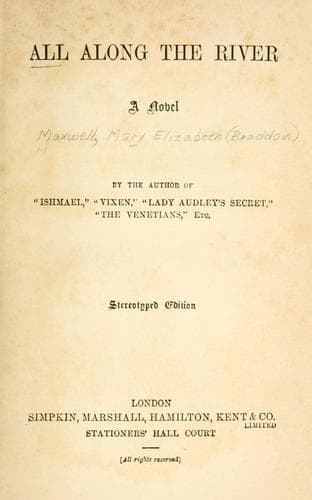
All along the River: A NovelBraddon, M. E. (Mary Elizabeth)
General
All along the River: A Novel
Braddon, M. E. (Mary Elizabeth)
English fiction -- 19th century
“She is ever so much wiser than I am,” he said. “So she had better be
my treasurer. My property is all in stocks and shares. My grandfather
was fond of stock-jobbing, and made some very lucky investments which
he settled upon my mother, with strict injunctions that they should
not be meddled with by her trustees. My share of her fortune comes to
a little over nine hundred a year. I came into possession of it when I
came of age, and it is mine to dispose of as I like, trusts expired,
trustees cleared off--in point of fact, both gone over to the majority,
poor old souls, after having had many an anxious hour about those South
American railway bonds, and Suez Canal shares, which turned up trumps
after all. I’ve telegraphed to the family lawyer for a schedule of the
property, and when that comes, just tie it all up in as tight a knot as
the law can tie, and let it belong to Allegra and her children after
her. Consider me paid off.”
Martin Disney laughed at the lover’s impetuosity--and told him that
he should be allowed to bring so much and no more into settlement.
Allegra’s income was less than two hundred a year, a poor little income
upon which she had fancied herself rich, so modest is woman’s measure
of independence as compared with man’s. It would be for the lawyer to
decide what proportion the husband’s settlements should bear to the
wife’s income. Father Rodwell had given Colonel Disney an introduction
to a solicitor of high character, a man who had occupied an excellent
position in London until damaged lungs obliged him to seek a home in
the south.
With this gentleman’s aid, matters were soon put in train, and while
the men were in the lawyer’s office, the two women were choosing
Allegra’s wedding-gown.
The young lady had exhibited a rare indifference upon the great
trousseau question. She was not one of those girls whose finery is all
external, and who hide rags and tatters under æsthetic colouring and
Raffaelle draperies. She was too much of an artist to endure anything
unseemly in her belongings, and her everyday clothes, just as they
were, might have been exhibited, like a Royal trousseau, without
causing any other comment than, “How nice!” “What good taste!” “What
exquisite needlework!”
The hands which painted such clever pictures were as skilful with
the needle as with the brush, and Allegra had never considered that
a vocation for art meant uselessness in every feminine industry. She
had attended to her own wardrobe from the time she learnt plain sewing
at her first school; and now, as she and Isola looked over the ample
array of under-linen, the pretty cambric peignoirs, and neatly trimmed
petticoats, they were both of one mind, that there was very little need
of fuss or expenditure.
“I have plenty of summer frocks,” said Allegra. “So really there is
only my travelling gown to see about, that is to say, the gown I am to
be married in.”
Public-domain text, read in full here on John Shaqi.
Reviews
Reviews
No reviews yet
Be the first to share your thoughts on this work.
Elsewhere in the archive
Join the Discussion
Join the discussion
Sign in to leave a comment or review.
Sign InorCreate an account