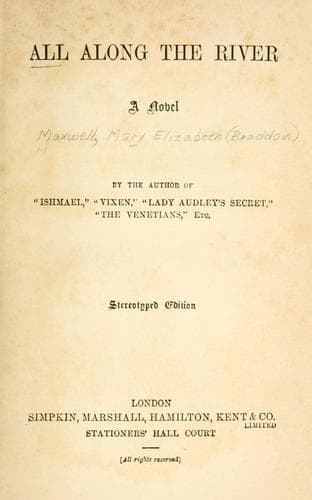
All along the River: A NovelBraddon, M. E. (Mary Elizabeth)
General
All along the River: A Novel
Braddon, M. E. (Mary Elizabeth)
English fiction -- 19th century
He knew that in this desire he exceeded the teaching of churchmen; that
another priest in his place might have bade her keep her sad secret to
the end, lie down with it in her early grave, be remembered as a saint,
yet die knowing herself a sinner. If he had thought of the husband’s
peace first, he would have counselled silence. But he thought most of
this stricken soul, with wings that spread themselves towards heaven,
held down to earth by the burden of an unpardoned sin.
He looked at her in the lamplight, and her eyes met his with a
straighter outlook than he had seen in them for a long time. She looked
actually happy, and that look of happiness in a face on which death
has set its seal has always something which suggests a life beyond the
grave.
“The excitement of this marriage question has brightened you
wonderfully, Mrs. Disney,” he said. “We shall have you in high health
by the wedding-day.”
“I am feeling better because I am so glad,” Isola answered naively,
putting her hand into Allegra’s.
“I consider it positively insulting to me as a sister,” exclaimed
Allegra, bending down to kiss the too-transparent hand--such a hand as
she had seen in many a picture of dying saint in the Roman galleries.
“You are most unaffectionately rejoiced to get rid of me. I have
evidently been a tyrannical nurse, and a dull companion, and you
breathe more freely at the prospect of release.”
“You have been all that is dear and good,” Isola answered softly, “and
I shall feel dreadfully lonely without you; but it won’t be for long.
And I shall be so comforted by the knowledge that nothing can come
between you and your life’s happiness.”
The two men came in from the loggia, bringing with them the cool breath
of night. Isola went to the piano and played one of those Adagios of
Mozart’s which came just within the limit of her modest powers, and
which she played to perfection, all her soul in the long lingering
phrases, the tender modulations, with their suggestions of shadowy
cathedral aisles, and the smoke of incense in the deepening dusk
of a vesper service. Those bits of Mozart, the slow movements from
the Sonatas, an Agnus Dei, or an Ave Maria from one of the Masses,
satisfied Captain Hulbert’s highest ideas of music. He desired nothing
grander or more scientific. The new learning of the Wagnerian school
had no charm for him.
“If you ask me about modern composers, I am for Verdi and Gounod,” he
said. “For gaiety and charm, give me Auber, Rossini, and Boieldieu--for
pathos, Weber--for everything, Mozart. There you have the whole of my
musical education.”
The question of settlements was opened seriously between Martin Disney
and his future brother-in-law, early on the following morning. Hulbert
wanted to settle all the money he had in the world upon Allegra.
Public-domain text, read in full here on John Shaqi.
Reviews
Reviews
No reviews yet
Be the first to share your thoughts on this work.
Elsewhere in the archive
Join the Discussion
Join the discussion
Sign in to leave a comment or review.
Sign InorCreate an account