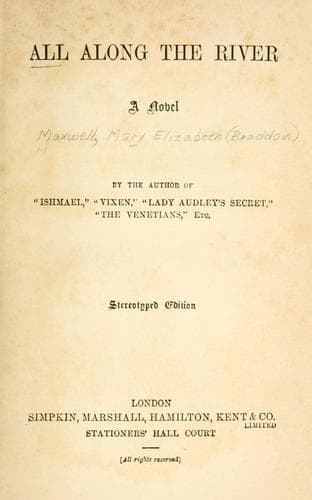
All along the River: A NovelBraddon, M. E. (Mary Elizabeth)
General
All along the River: A Novel
Braddon, M. E. (Mary Elizabeth)
English fiction -- 19th century
Vaguely, as in a dream, she saw the lights and the flowers, the satin
gowns and the diamonds, the scarlet and white upon the walls, brush
and vizard, vizard and brush. He was not there. She looked along the
crowd, and that tall figure and that dark head were absent. She ought
to have been glad at this respite, and yet her heart grew heavy as lead.
Later he was there, and she was waltzing with him. At the last moment
when he was standing before her, cool, self-possessed, as it were
unconscious of that burning past, she had no more power to refuse to
be his partner than the bird has to escape from the snake. She had
given him her hand, and they were moving slowly, softly to the music
of the soft, slow waltz. Myosotis, myosotis--mystic flower which means
everlasting remembrance! Would she ever forget this night? Their
last meeting--safest possible meeting-place here in the shine of the
lamps--in the sight of the multitude. Here she could so easily hold him
at a distance. Here she might speak to him lightly, as if she too were
unconscious of the past. Here she was safe against his madness and her
own weak unstable heart, which fluttered at his smallest word.
And so the night wore on, and she danced with him more times than she
could count, forgetting, or pretending to forget, other engagements;
going through an occasional waltz with another partner just for
propriety’s sake, and hardly knowing who that partner was; knowing so
well that there was some one else standing against the wall, watching
her every movement, with the love-light in his eyes.
Then came the period after supper when they sat in the ante-room and
let the dances go by, hearing the music of waltzes which they were to
have danced together, hearing and heeding not. And then came a sudden
scare at the thought of the hour. Was it late?
Late, very late!
The discovery fluttered and unnerved her, and she was scarcely able to
collect her thoughts as he handed her into the carriage and shut the
door.
“Surely it was a grey horse that brought me!” she exclaimed, and
in the next minute she recognized Lostwithiel’s brougham, the same
carriage in which she had been driven home through the rain upon that
unforgotten night when his house sheltered her, when she saw his face
for the first time.
Yes, it was his carriage. She knew the colour of the lining, the little
brass clock, the reading-lamp, the black panther rug. She pulled at the
check-string, but without effect. The carriage drove on, slowly, but
steadily, to the end of the town. She let down the window and called to
the coachman. There was only one man on the box, and he took no notice
of her call.
Yes, he had heard, perhaps, for he drew up his horse suddenly by the
road-side, a little way beyond the town. A man opened the door and
sprang in, breathless after running. It was Lostwithiel.
“You put me into your carriage!” she cried distractedly. “How could you
make such a mistake? Pray tell him to go back to the inn directly.”
Public-domain text, read in full here on John Shaqi.
Reviews
Reviews
No reviews yet
Be the first to share your thoughts on this work.
Elsewhere in the archive
Join the Discussion
Join the discussion
Sign in to leave a comment or review.
Sign InorCreate an account