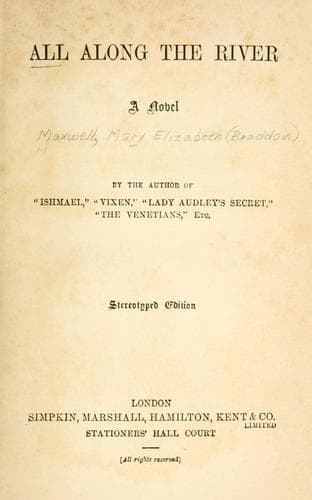
All along the River: A NovelBraddon, M. E. (Mary Elizabeth)
General
All along the River: A Novel
Braddon, M. E. (Mary Elizabeth)
English fiction -- 19th century
They were driving along the country road at a rapid pace, and he had
seated himself by her side, clasping her hand. He pulled up the window
nearest her, and prevented her calling to the coachman.
“Why should you go back? You will be home sooner with my horse than
with the screw that brought you.”
“But the fly will be waiting for me--the man will wonder.”
“Let him wonder. He won’t wait very long, you may be assured. He will
guess what has happened. In the confusion of carriages you took the
wrong one. Isola, I am going to leave Cornwall to-night--to leave
England--perhaps never to return. Give me the last few moments of my
life here. Be merciful to me. I am going away--perhaps for ever.”
“Take me home,” she said. “Are you really taking me home? Is this the
right way?”
“Of course it is the right way. Do you suppose I am going to drive you
to London?”
He let down the glass suddenly, and pointed into the night.
“Isola, do you see where we are? There’s the sign-post at the cross
roads. There’s the tower of Tywardreath Church, though you can hardly
see it in this dim light. Are you satisfied now?”
He had drawn up the glass again. The windows were clouded by the mist
of their mingled breath; the atmosphere was faint with the odour of the
faded chrysanthemums on her gown and the carnation in the lapel of his
coat. All that she could see of the outer world was the blurred light
of the carriage lamps. The high-spirited horse was going up and down
the hills at a perilous pace. At this rate the journey could not take
long.
And then--and then--he came back to the prayer he had breathed in her
ear more than twelve hours ago in the wintry lane. He loved her, he
loved her, he loved her! Could she refuse to go away with him--having
woven herself into his life, having made him madly, helplessly in love
with her? Could she refuse? Had any woman the right to refuse? He
appealed to her sense of honour. She had gone too far--she had granted
too much already, granting him her love. She was in his arms in the dim
light, in the faint, dream-like atmosphere. He was taking possession of
her weak heart by all that science of love in which he was past master.
Honour, conscience, fidelity to the absent, piety, innocence were being
swept away in that lava flood of passion. Helpless, irresolute, she
faltered again and again. “Take me home, Lostwithiel! Have mercy! Take
me home.”
He stopped those tremulous lips with a kiss--the kiss that betrays. The
carriage dashed down a steep bill, rattled along a street so narrow
that the wheels seemed to grind against the house-fronts on each side,
down hill again, and then the horse was pulled up suddenly in a stony
square, and the door opened, and the soft, fresh sea-breeze blew among
her loosened hair, and upon her uncovered neck, and she heard the
gentle plish-plash of a boat moored against the quay at her feet.
“This is not home!” she cried piteously.
Public-domain text, read in full here on John Shaqi.
Reviews
Reviews
No reviews yet
Be the first to share your thoughts on this work.
Elsewhere in the archive
Join the Discussion
Join the discussion
Sign in to leave a comment or review.
Sign InorCreate an account