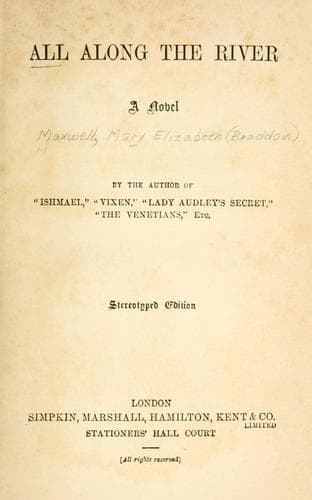
All along the River: A NovelBraddon, M. E. (Mary Elizabeth)
General
All along the River: A Novel
Braddon, M. E. (Mary Elizabeth)
English fiction -- 19th century
Oh, those passionate, never-to-be-forgotten moments, when she had
stood with him at the top of the companion, looking out upon those
livid waters; fondly believing that each moment was to be their last;
that the gates of death were opening yonder--a watery way, a gulf to
which they must go down, in a moment, in a little moment, in a flash,
in a breath, at the next, or the next, or the next mad plunge of that
hurrying bark. Yes, death was there, in front of them--inevitable,
imminent, immediate--and life and sin, shame, remorse, were done with,
along with the years that lay behind them, a page blotted and blurred
with one passionate madness, which had changed the colour of a woman’s
life. She knew not how she bore up against the force of that tempest;
clinging to him with her bare, wet arms; held up by him; crouching
against the woodwork, which shook and rattled with every blow of the
battering-rams. She only knew that his arms were round her, that she
was safe with him, even when the leaping surf rose high above her head,
wrapping her round like a mantle, blinding, drowning her in a momentary
extinction. She only knew that his lips were close to her ear, and that
in a momentary lull of those awful voices he murmured, “We are going
to die, Isola! The boat cannot live through such a storm! We shall go
down to death together!” And her lips turned to him with a joyful cry,
“Thank God!” Then again, in a minute’s interval, he pleaded, “Forgive
me, love; my stolen love, forgive me before we die!” And again, “Was it
a crime, Isola?” “If it was, I forgive you!” she whispered, clinging to
him as the blast struck them.
* * * * *
Cruel revulsion of feeling, bitter irony of Fate, when the great grim
waves--which had seemed like living monsters hurrying down upon them
with malignant fury to tear and to devour--when the awful sea began to
roar with a lesser voice, and the thunder of the battering-rams had
a duller sound, and the bows of the yacht no longer plunged straight
down into the leaden-coloured pit; no longer climbed those inky ridges
with such blind impetus, as of a cockle-shell in a whirlpool. Bitter
sense of loss and dismay when the grey, cold dawn lighted a quieter
sea, and she heard the captain telling Lostwithiel that they had seen
the worst of the storm, and that there was no fear now. He was going to
put on more canvas: and hadn’t the lady better go below, where it was
warm. She needn’t feel anyway nervous now. They would soon be in the
roadstead of Arcachon.
She had not felt the chill change from night to morning. She had not
felt the surf that drenched her loose, entangled hair. She hardly know
when or how Lostwithiel had wrapped her in his fur-lined coat; but
she found that she was so enveloped presently when she stumbled and
staggered down to the cabin, and flung herself face downward upon the
sofa, in a paroxysm of impotent despair.
Public-domain text, read in full here on John Shaqi.
Reviews
Reviews
No reviews yet
Be the first to share your thoughts on this work.
Elsewhere in the archive
Join the Discussion
Join the discussion
Sign in to leave a comment or review.
Sign InorCreate an account