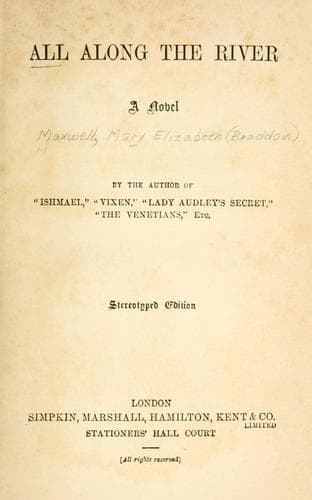
All along the River: A NovelBraddon, M. E. (Mary Elizabeth)
General
All along the River: A Novel
Braddon, M. E. (Mary Elizabeth)
English fiction -- 19th century
She flung her arms above her head and wrung her hands in a paroxysm
of despair. Then, with a little cry, she plucked at the loose wild
tresses as if she would have torn them from her head; and then she
threw herself upon the cabin floor in her agony, and grovelled there, a
creature for whom death would have been a merciful release.
“If I could die--if I could but die, and no one know!” she moaned.
She lifted herself up again upon her knees, and, with one hand upon
the floor, looked round the walls of the cabin--looked at a trophy
of Moorish and Italian arms which decorated the panelling, searching
for some sharp dagger with which she might take her hated life. And
then came the thought of what must follow death, not for her in
the dim incomprehensible eternity, but for those who loved her on
earth, for those who would have to be told how she had been found,
in her draggled wedding-gown, stabbed by her own hand on board Lord
Lostwithiel’s yacht. What a story of shame and crime for newspapers
to embellish, and for scandal-lovers to gloat over! No! She dared not
destroy herself thus. She must collect her senses, escape from her
seducer, and keep the secret of her dishonour.
She took off her gown, and rolled train and bodice into a bundle as
small as she could make them. Then she looked about the cabin for some
object with which to weight her bundle. Yes, that would do. A little
brass dolphin that was used to steady the open door. That was heavy
enough, perhaps. She put it into the middle of her bundle, tied a
ribbon tightly round the whole, and then she opened the scuttle port
and dropped her wedding-garment into the sea. The keen fresh wind, the
wind from pine-clad hills and distant snow mountains, blew in upon
her bare neck and chilled her; but it helped to cool the fever of her
mind, and she sat down and leant her head upon her clasped hands, and
tried to think what she must do to free herself from the toils in which
guilty love had caught her.
She must escape from the yacht. She must go back to England--somehow.
She thought that if she were to appeal to Lostwithiel’s honour
some spark of better feeling would prevail over that madness which
had wrecked her, and he would let her go, he would take her back
to England, and facilitate her secret return to the home she had
dishonoured. But could she trust herself to make that appeal? Could
she stand fast against his pleading, if he implored her to stay with
him, to live the life that he had planned for her, the life that he had
painted so eloquently, the dreamy, beautiful life amidst earth’s most
romantic scenes, the life of love in idleness? Could she resist him
if he should plead--it might be with tears--he, whom she adored, her
destroyer and her divinity? No, she must leave the yacht before he came
back to her. But how?
Public-domain text, read in full here on John Shaqi.
Reviews
Reviews
No reviews yet
Be the first to share your thoughts on this work.
Elsewhere in the archive
Join the Discussion
Join the discussion
Sign in to leave a comment or review.
Sign InorCreate an account