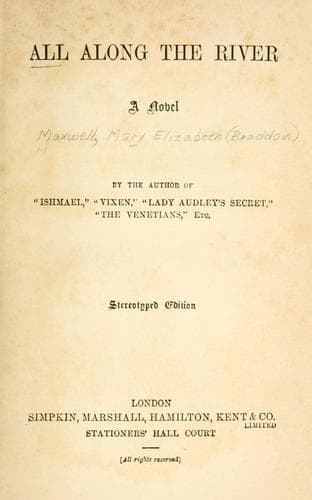
All along the River: A NovelBraddon, M. E. (Mary Elizabeth)
General
All along the River: A Novel
Braddon, M. E. (Mary Elizabeth)
English fiction -- 19th century
She thought, with a half-smile, of yesterday’s adventure. What
importance that foolish Tabitha gave to so simple an incident; the
merest commonplace courtesy, necessitated by circumstances; and
only because the person who had been commonly courteous was Richard
Hulbert, thirteenth Baron Lostwithiel. Thirteenth Baron! There lay
the distinction. These Cornish folks worshipped antique lineage.
Tabitha would have thought very little of a mushroom peer’s civility,
although he had sent her mistress home in a chariot and four. She was
no worshipper of wealth, and she turned up her blunt old nose at Mr.
Crowther, of Glenaveril--the great new red-brick mansion which had
sprung up like a fungus amidst the woods only yesterday--because he had
made his money in trade, albeit his trade had been upon a large scale,
and altogether genteel and worthy to be esteemed--a great cloth factory
at Stroud, which was said to have clad half the army at one period of
modern history.
Poor, foolish Tabitha! What would she have thought of the tea-drinking
in that lovely old room, mysteriously beautiful in the light of a
wood fire--the playful, uncertain light which glorifies everything?
What would she have thought of those walls of books--richly bound
books, books in sombre brown, big books and little books, from floor
to ceiling? A room which made those poor little oak bookcases in the
cottage parlour something to blush for. What would Tabitha have thought
of his deferential kindness--that tone of deepest consideration with
which such men treat all women, even the old and uncomely? She could
hardly have helped admiring his good manners, whatever dark things she
might have been told about his earlier years.
Why should he not have a yacht? It seemed the fittest life for a man
without home ties; a man still young, and with no need to labour at a
profession. What better life could there be than that free wandering
from port to port over a romantic sea?--and to Isola all seas were
alike mysterious and romantic.
She dawdled away the morning; she sculled against the stream for nearly
three hours, and then let her boat drift down the river to the garden
above the towpath. It was long past her usual time for luncheon when
she moored her boat to the little wooden steps, leaving it for Thomas,
the gardener, to pull up into the boat-house. She had made up her mind
that if Lostwithiel troubled himself to make any inquiry about her
health he would call in the morning.
Public-domain text, read in full here on John Shaqi.
Reviews
Reviews
No reviews yet
Be the first to share your thoughts on this work.
Join the Discussion
Join the discussion
Sign in to leave a comment or review.
Sign InorCreate an account