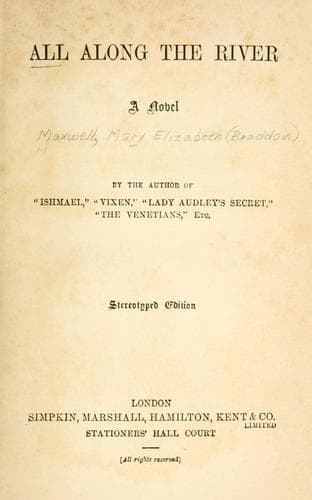
All along the River: A NovelBraddon, M. E. (Mary Elizabeth)
General
All along the River: A Novel
Braddon, M. E. (Mary Elizabeth)
English fiction -- 19th century
Fortune had favoured this last of the Crowthers, and, at forty years
of age, he had found himself rich enough to dispose of his business
to two younger brothers and a brother-in-law, and to convert himself
into a landed proprietor. He bought up all the land that was to be had
about Trelasco. Cornish people cling to their land like limpets to a
rock; and it was not easy to acquire the ownership of the soil. In the
prosperous past, when land was paying nearly four per cent. in other
parts of England, Cornishmen were content to hold estates that yielded
only two per cent.; but the days of decay had come when Mr. Crowther
entered the market, and he was able to buy out more than one gentleman
of ancient lineage.
When he had secured his land, he sent to Plymouth for an architect, and
he so harried that architect and so tampered with his drawings that
the result of much labour and outlay was that monstrosity in red brick
with stone dressings, known in the neighbourhood as Glenaveril. Mr.
Crowther’s elder daughter was deep in Lord Lytton’s newly published
poem when the house was being finished, and had imposed that euphonious
name upon her father. Glenaveril. The house really was in a glen,
or at least in a wooded valley, and Glenaveril seemed to suit it to
perfection; and so the romantic name of a romantic poem was cut in
massive Gothic letters on the granite pillars of Vansittart Crowther’s
gate, beneath a shield which exhibited the coat of arms made and
provided by the Herald’s College.
Mrs. Vansittart Crowther was at home on Thursday afternoons, when the
choicest Indian tea and the thickest cream, coffee as in Paris, and
the daintiest cakes and muffins which a professed cook could provide,
furnished the zest to conversation; for it could scarcely be said that
the conversation gave a zest to those creature comforts. It would be
perhaps nearer the mark to say that Mrs. Crowther was supposed to sit
in the drawing-room on these occasions while the two Miss Crowthers
were at home. The mistress of Glenaveril was not an aspiring woman; and
in her heart of hearts she preferred Gloucestershire to Cornwall, and
the stuccoed villa on the Cheltenham road, with its acre and a half
of tennis-lawn and flower-beds, open to the blazing sun, and powdered
with the summer dust, to Glenaveril, with its solemn belt of woodlands,
and its too spacious grandeur. She was not vulgar or illiterate. She
never misplaced an aspirate. She had learnt to play the piano and to
talk French at the politest of young ladies’ schools at Cheltenham.
She never dressed outrageously, or behaved rudely. She had neither red
hands nor splay feet. She was in all things blameless; and yet Belinda
and Alicia, her daughters, were ashamed of her, and did their utmost
to keep her, and her tastes, and her opinions in the background. She
had no style. She was not “smart.” She seemed incapable of grasping
the ideas, or understanding the ways of smart people; or at least her
daughters thought so.
Public-domain text, read in full here on John Shaqi.
Reviews
Reviews
No reviews yet
Be the first to share your thoughts on this work.
Join the Discussion
Join the discussion
Sign in to leave a comment or review.
Sign InorCreate an account