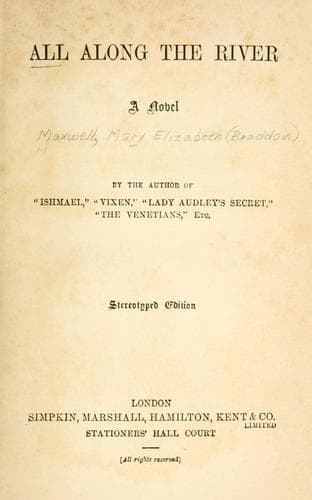
All along the River: A NovelBraddon, M. E. (Mary Elizabeth)
General
All along the River: A Novel
Braddon, M. E. (Mary Elizabeth)
English fiction -- 19th century
Mrs. Disney hated the great red-brick porch, with its vaulted roof and
monstrous iron lantern, and the bell which made such a clamour, as if
it meant fire, or at least dinner, when she touched the hanging brass
handle. She hated to find herself face to face with a tall footman,
who hardly condescended to say whether his mistress were at home or
not, but just preceded her languidly along the broad corridor, where
the carpet was so thick that it felt like turf, and flung open the
drawing-room door with an air, and pronounced her name into empty
space, so remote were the half-dozen ladies at the other end of the
room, clustered round Belinda’s tea-table, and fed with cake by
Alicia, while Mrs. Crowther sat in the window a little way off, with
her basket of woolwork at her side, and her fat somnolent pug lying
at her feet. To Isola it was an ordeal to have to walk the length
of the drawing-room, navigating her course amidst an archipelago of
expensive things--Florentine tables, portfolios of engravings, Louis
Seize Jardinières, easels supporting the last expensive etching
from Goupil’s--to the window where Mrs. Crowther waited to receive
her, rising with her lap full of wools, to shake hands with simple
friendliness and without a vestige of style. Belinda shook hands
on a level with the tip of her sharp _retroussé_ nose, and twirled
the silken train of her tea-gown with the serpentine grace of Sarah
Bernhardt. She prided herself on those serpentine movements and languid
graces which belong to the Græco-Belgravian period; while Alicia
held herself like a ramrod, and took her stand upon being nothing
if not sporting. Her olive-cloth gown and starched collar, her neat
double-soled boots and cloth gaiters, were a standing reproach to
Belinda’s silken slovenliness and embroidered slippers, always dropping
off her restless feet, and being chased surreptitiously among her lace
and pongee frillings. Poor Mrs. Crowther disliked the Guard’s collar,
which she felt was writing premature wrinkles upon her younger girl’s
throat, but she positively loathed the loose elegance of the Indian
silk tea-gown, with its wide Oriental sleeves, exhibiting naked arms
to the broad daylight. That sloppy raiment made a discord in the
subdued harmony of the visitors’ tailor-made gowns--well worn some of
them--brown, and grey, and indigo, and russet; and Mrs. Crowther was
tortured by the conviction that her elder daughter looked disreputable.
This honest matron was fond of Isola Disney. In her own simple
phraseology, she had “taken to her;” and pressed the girl-wife to come
every Thursday afternoon.
“It must be so lonely for you,” she said gently, “with your husband so
far away, and you such a child, too. I wonder your mamma doesn’t come
and stay with you for a bit. You must always come on our Thursdays. Now
mind you do, my dear.”
Public-domain text, read in full here on John Shaqi.
Reviews
Reviews
No reviews yet
Be the first to share your thoughts on this work.
Join the Discussion
Join the discussion
Sign in to leave a comment or review.
Sign InorCreate an account