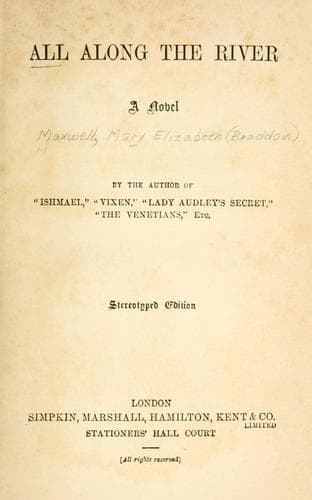
All along the River: A NovelBraddon, M. E. (Mary Elizabeth)
General
All along the River: A Novel
Braddon, M. E. (Mary Elizabeth)
English fiction -- 19th century
She went out to walk down her depression before teatime, if possible.
She went along a narrow path by the river, then turned into a road
that skirted those green pastures which rose sheer till the ragged edge
of the topmost boundary seemed to touch the dim, grey sky. She passed
the village inn, deadly quiet at this season and at this hour. She
passed the half-dozen decent cottages, and the three or four genteeler
houses, each in its neatly kept garden, and she walked with quick,
light step along the wet road, her useful tailor-gown well clear of the
mud, her stick striking the hedgerow now and then, as she swung it to
and fro in dreamy thought.
A long, lonely winter to look forward to--a winter like the last--with
her books and drawing-board, and her cottage piano, and the cat and the
fox-terrier, and Tabitha for her daily companions. There were a few
neighbours within a radius of half a dozen miles, who had been very
civil to her; who called upon her, say once in six weeks; who sometimes
invited her to a stately dinner-party, and sometimes at a suspiciously
short notice, which made her feel she was wanted to fill a gap; who
made her free of their tennis lawns; and who talked to her on Sundays
after church, and were always very particular in inquiring for news
from India. There was not one among them for whom she cared; not one
to whom she would have liked to pour out her thoughts about Keats or
Shelley, or to whom she would have confided her opinion of Byron. She
was more interested in Bulwer’s “Audley Egerton” than in any of those
flesh and blood neighbours. She was happier sitting by her chimney
corner with a novel than in the best society available within a drive
of Trelasco.
She struck off the high road into a lane, a lane that led to the base
of a wilder hill than that where the red cattle were grazing. The
crest of the hill was common land, and dark fir-trees made a ragged
line against the autumn sky, and the view from the summit was wide and
varied, with a glimpse of the great brown cliffs and the dark, grey
sea far off to the west, to that dim distance where the Dodman shut
off the watery way to the new world. On the landward slope of that
wild-looking ridge was the Mount, Lord Lostwithiel’s place, uninhabited
for the greater part of the year except by servants, his lordship being
the very last kind of man to bury himself alive in a remote Cornish
fastness, a long day’s journey from the London theatres, and the R.Y.S.
Clubhouse at Cowes.
Who was Lord Lostwithiel? Well, in the estimation of Trelasco he was
the only nobleman in England, or say that he was to all other peers as
the sun to the planets. He belonged to Trelasco by reason of his large
landed estate and the accident of his birth, which had taken place
at the Mount; and, although his character and way of life were not
altogether satisfactory to the village mind, Trelasco made the best of
him.
Public-domain text, read in full here on John Shaqi.
Reviews
Reviews
No reviews yet
Be the first to share your thoughts on this work.
Join the Discussion
Join the discussion
Sign in to leave a comment or review.
Sign InorCreate an account