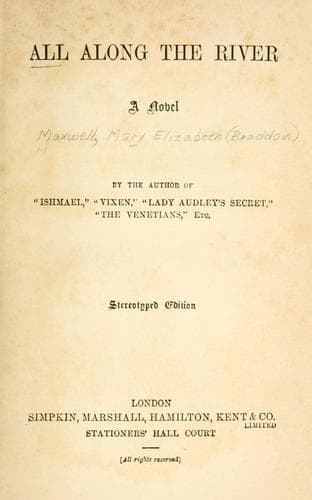
All along the River: A NovelBraddon, M. E. (Mary Elizabeth)
General
All along the River: A Novel
Braddon, M. E. (Mary Elizabeth)
English fiction -- 19th century
“I dare say if I were daring enough to open one of the doors and go in
I should find them all asleep,” she thought, “and I might roam all over
the house without awakening anybody.” She was too depressed to-day to
give more than a careless, unseeing glance at those many gables as she
walked along the muddy path beside the dripping copse. The chestnut
boughs were nearly bare, but here and there clusters of bright yellow
leaves were still hanging, shining like pale gold in the last watery
gleams of the sun; and though the leaves were lying sodden and brown
among the rank, wet grass, there were emerald mosses and cool, green
ferns, and red and orange fungi to give colour to the foreground, and
to the little vistas that opened here and there amidst the underwood.
Those final yellow gleams were fading low down in the western sky as
Isola turned her face towards the river and the Angler’s Nest, and just
above that pale radiance there stretched a dense black cloud, like a
monstrous iron bar, which she felt must mean mischief. She looked at
that black line apprehensively. She was three miles from home, without
cloak or umbrella, and with no available shelter within three-quarters
of a mile.
She quickened her pace, watching the fading light and lowering cloud,
expecting thunder, lightning, hail, she knew not what. A sudden deluge
settled the question. Torrential rain! That was the meaning of the inky
bar above the setting sun. She looked round her helplessly. Should she
dart into the copse, and try to shelter herself amidst those leafless
twigs, those slender withies and saplings? Better to face the storm
and plod valiantly on. Her neat little cloth gown would not be much
the worse for a ducking; her neat little feet were accustomed to rapid
walking. Should she run? No; useless when there were three miles to
be got over. A brisk, steady tramp would be better. But, brave as she
was, that fierce rain was far from pleasant. It cut into her eyes and
blinded her. She had to grope her way along the path with her stick.
“Pray let me take you to the house,” said a voice close beside her, a
man’s voice--low and deep, and with the accents of refinement.
Could one of Lord Lostwithiel’s fossilized servants talk like that?
Impossible. She looked up, as well as she could, under that blinding
downpour, and saw a tall man standing beside the pathway with his back
to the copse. He was over six feet two and of slim, active figure. He
was pale, and wore a short, dark beard, and the eyes which looked at
Isola out of the pale, thin face were very dark. That was about as much
as she could see of the stranger in the November dusk.
“Pray let me persuade you to come to the house,” he said urgently. “You
are being drenched. It is absolutely dreadful to see anybody out in
such rain--and there is no other shelter within reach. Let me take you
there. My housekeeper will dry your hat and jacket for you. I ought to
introduce myself, perhaps. I am Lord Lostwithiel.”
Public-domain text, read in full here on John Shaqi.
Reviews
Reviews
No reviews yet
Be the first to share your thoughts on this work.
Join the Discussion
Join the discussion
Sign in to leave a comment or review.
Sign InorCreate an account