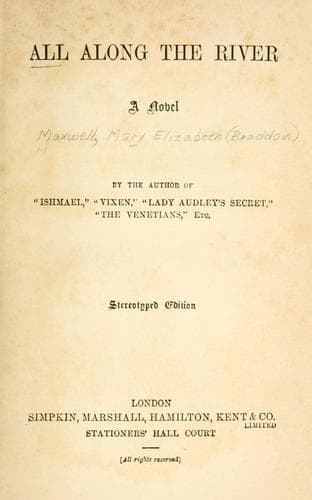
All along the River: A NovelBraddon, M. E. (Mary Elizabeth)
General
All along the River: A Novel
Braddon, M. E. (Mary Elizabeth)
English fiction -- 19th century
She might never enter it again, perhaps. Lord Lostwithiel was so seldom
there. His absenteeism was the lament of the neighbourhood. The things
he ought to have done and did not do would have filled a book. He had
been wild in his youth. He had once owned a theatre. He had done, or
was supposed to have done, things which were spoken of with bated
breath; but of late years he had developed new ambitions, and had done
with theatrical speculations. He had become literary, scientific,
political. He was one of the lights of the intellectual world, or of
that small section of the intellectual world which is affiliated to the
smart world. He knew all the clever people in London, and a good many
of the intellectualities of Paris, Berlin, and Vienna. He had never
married; but it was supposed that he would eventually marry, before he
was forty, for instance, and that he would make a great match. He was
not rich, but he was Lord Lostwithiel. He was by no means handsome, but
he was said to be one of the most fascinating men in London.
Isola pulled off her jacket slowly, looking about her all the time; and
Lostwithiel forbore from offering her any assistance, lest he should
intensify her evident shyness.
A man in plain clothes, who looked more like a valet than a butler,
answered the bell.
“Send Mrs. Mayne, and bring tea,” ordered his lordship.
What a slender, girlish form it was which the removal of the tweed
jacket revealed! The slim waist and somewhat narrow shoulders betokened
a delicacy of constitution. The throat was beautiful, milk white, the
throat of Diana, and the head, now the hat was off, would also have
done for Diana; a small classic head, with soft, brown hair drawn
smoothly away from the low, white brow and rolled into a knot at the
back. The features were as delicate as the complexion, in which there
was no brilliancy of colouring, only a paleness as of ivory. The eyes
were dark grey, with long, brown lashes, and their present expression
was between anxiety and wondering interest. Lostwithiel was not such a
coxcomb as to appropriate that look of interest. He saw that it was his
house and not himself which inspired the feeling.
“You like old houses, I can see, Mrs. Disney,” he said, smiling at her.
“Intensely. They are histories in brick and stone, are they not? I dare
say there are stories about this room.”
“Innumerable stories. I should have to ransack the Record Office for
some of them, and to draw upon a very bad memory to a perilous extent
for others.”
“Is it haunted?”
Public-domain text, read in full here on John Shaqi.
Reviews
Reviews
No reviews yet
Be the first to share your thoughts on this work.
Join the Discussion
Join the discussion
Sign in to leave a comment or review.
Sign InorCreate an account