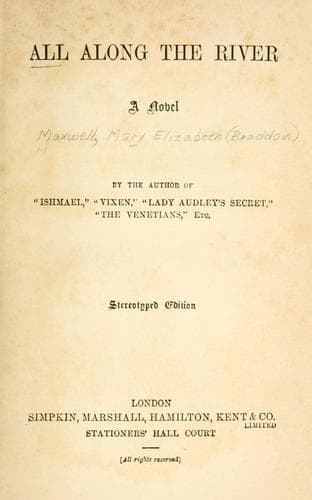
All along the River: A NovelBraddon, M. E. (Mary Elizabeth)
General
All along the River: A Novel
Braddon, M. E. (Mary Elizabeth)
English fiction -- 19th century
“I used to take the train for Hampstead Heath or Willesden,” she told
her brother, “and go off for long, lonely tramps to Finchley or Hendon.
I have watched the builder’s progress along roads and lanes I loved.
I have seen horrid brick boxes creeping along like some new kind of
noxious insect, eating up fields and hedgerows, old hawthorns and old
hollies. I could have sat down in the muddy road and cried sometimes,
at the thought that soon there would be no country walk left within
reach of a Londoner. Once I went off to the north-east, to look for the
rural lanes Charles Lamb and his sister loved--the lanes and meadows
where they carried their little picnic basket, till they took shelter
at a homely inn. Oh, Martin, all those fields and lanes, Charles
Lamb’s country--are going, going, or gone! It is heartbreaking! And
they are building at Fowey, too, I see. Positively there will be no
country anywhere soon. There will be crescents and terraces and little
ugly streets at the very Land’s End, and the Logan Rock will be the
sign of a public-house.”
“Don’t be down-hearted, Chatterbox! I think Cornwall may last our
time,” said Disney, laughing at her vehemence.
Allegra was a great talker. It seemed as if she had a well-spring of
joy and life within her which must find an outlet. When people ventured
to hint at her loquacity she declared that her name was in fault.
“I have grown up to match my name,” she said; “if I had been christened
Penserosa I might have been quite a different person.”
Her vivacity gave a new element of brightness to the Angler’s Rest,
where Disney had been somewhat oppressed by the sensation of intense
repose which had pervaded his _tête-à-tête_ life with Isola. He loved
his wife so entirely, so unselfishly, and devotedly, that it was
happiness to him to be with her; yet in the three or four weeks that
had gone by since his return he had struggled in vain against the
feeling that there was something wanting in his home. Isola waited
upon him and deferred to him with more than wifely submissiveness. He
would have liked a spurt of rebellion once in a way, a little burst of
girlish temper, just to show that she was human; but none ever came.
His every desire was anticipated. Whatever plan he suggested--to walk,
to drive, to visit, or not to visit--the river or the sea--was always
the plan that pleased her best, or at least she said so.
“I think I shall call you Griselda instead of Isola,” he said one
day, taking the fair pale face between his hands and gazing into the
mournful depths of the dark violet eyes--inscrutable eyes they seemed
to him, when the pupils dilated under his gaze, as if the eyes made a
darkness to hide their meaning.
“Why?” she asked.
A flood of crimson passed over her face like a fire, and left her paler
than before.
“Because you are only too dutiful. Would you resist if I were to turn
tyrant, I wonder?”
Public-domain text, read in full here on John Shaqi.
Reviews
Reviews
No reviews yet
Be the first to share your thoughts on this work.
Elsewhere in the archive
Join the Discussion
Join the discussion
Sign in to leave a comment or review.
Sign InorCreate an account