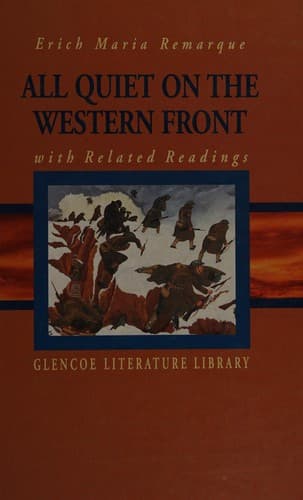
All quiet on the Western FrontRemarque, Erich Maria
History
All quiet on the Western Front
Remarque, Erich Maria
War stories; World War, 1914-1918 -- Fiction
On the way without my having noticed it, Kat has caught a splinter in
the head. There is just one little hole, it must have been a very
tiny, stray splinter. But it has sufficed. Kat is dead.
Slowly I get up.
"Would you like to take his pay book and his things?" the
lance-corporal asks me.
I nod, and he gives them to me.
The orderly is mystified. "You are not related, are you?"
No, we are not related. No, we are not related.
Do I walk? Have I feet still? I raise my eyes, I let them move
round, and turn myself with them, one circle, one circle, and I stand
in the midst. All is as usual. Only the Militiaman Stanislaus
Katczinsky has died.
Then I know nothing more.
CHAPTER XII
It is autumn. There are not many of the old hands left. I am the
last of the seven fellows from our class.
Everyone talks of peace and armistice. All wait. If it again proves
an illusion, then they will break up; hope is high, it cannot be
taken away again without an upheaval. If there is not peace, then
there will be revolution.
I have fourteen days rest, because I have swallowed a bit of gas; in
a little garden I sit the whole day long in the sun. The armistice
is coming soon, I believe it now too. Then we will go home.
Here my thoughts stop and will not go any farther. All that meets
me, all that floods over me are but feelings--greed of life, love of
home, yearning of the blood, intoxication of deliverance. But no
aims.
Had we returned home in 1916, out of the suffering and the strength
of our experiences we might have unleashed a storm. Now if we go
back we will be weary, broken, burnt out, rootless, and without hope.
We will not be able to find our way any more.
And men will not understand us--for the generation that grew up
before us, though it has passed these years with us here, already had
a home and a calling; now it will return to its old occupations, and
the war will be forgotten--and the generation that has grown up after
us will be strange to us and push us aside. We will be superfluous
even to ourselves, we will grow older, a few will adapt themselves,
some others will merely submit, and most will be bewildered;--the
years will pass by and in the end we shall fall into ruin.
But perhaps all this that I think is mere melancholy and dismay,
which will fly away as the dust, when I stand once again beneath the
poplars and listen to the rustling of their leaves. It cannot be
that it has gone, the yearning that made our blood unquiet, the
unknown, the perplexing, the oncoming things, the thousand faces of
the future, the melodies from dreams and from books, the whispers and
divinations of women, it cannot be that this has vanished in
bombardment, in despair, in brothels.
Here the trees show gay and golden, the berries of the rowan stand
red among the leaves, country roads run white out to the sky line,
and the canteens hum like beehives with rumours of peace.
I stand up.
Public-domain text, read in full here on John Shaqi.
Reviews
Reviews
No reviews yet
Be the first to share your thoughts on this work.
Elsewhere in the archive
Join the Discussion
Join the discussion
Sign in to leave a comment or review.
Sign InorCreate an account