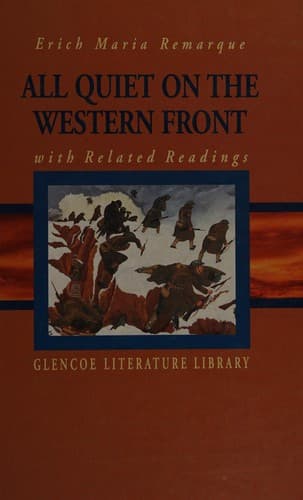
All quiet on the Western FrontRemarque, Erich Maria
History
All quiet on the Western Front
Remarque, Erich Maria
War stories; World War, 1914-1918 -- Fiction
On the landing I stumble over my pack which lies there already made
up, because I have to leave early in the morning.
I bite into my pillow. I grasp the iron rods of my bed with my
fists. I ought never to have come here. Out there I was indifferent
and often hopeless;--I will never be able to be so again. I was a
soldier, and now I am nothing but an agony for myself, for my mother,
for everything that is so comfortless and without end.
I ought never to have come on leave.
CHAPTER VIII
I already know the camp on the moors. It was here that Himmelstoss
gave Tjaden his education. But now I know hardly anyone here; as
ever, all is altered. There are only a few people that I have
occasionally met before.
I go through the routine mechanically. In the evenings I generally
go to the Soldiers' Home, where the newspapers are laid out, but
which I do not read; still, there is a piano there that I am glad
enough to play on. Two girls are in attendance, one of them is young.
The camp is surrounded with high barbed-wire fences. If we come back
late from the Soldiers' Home we have to show passes. But those who
are on good terms with the guard can get through, of course.
Between the junipers and the birch trees on the moor we practice
company-drill each day. It is bearable if one expects nothing
better. We advance at a run, fling ourselves down, and our panting
breath moves the stalks of the grasses and the flowers of the heather
to and fro. Looked at so closely one sees the fine sand is composed
of millions of the tiniest pebbles as clear as if they had been made
in a laboratory. It is strangely inviting to dig one's hands into it.
But most beautiful are the woods with their line of birch trees.
Their colour changes with every minute. Now the stems gleam purest
white, and between them airy and silken, hangs the pastel-green of
the leaves; the next moment all changes to an opalescent blue, as the
shivering breezes pass down from the heights and touch the green
lightly away; and again in one place it deepens almost to black as a
cloud passes over the sun. And this shadow moves like a ghost
through the dim trunks and passes far out over the moor to the
sky--then the birches stand out again like gay banners on white
poles, with their red and gold patches of autumn-tinted leaves.
I often become so lost in the play of soft light and transparent
shadow, that I almost fail to hear the commands. It is when one is
alone that one begins to observe Nature and to love her. And here I
have not much companionship, and do not even desire it. We are too
little acquainted with one another to do more than joke a bit and
play poker or nap in the evenings.
Alongside our camp is the big Russian prison camp. It is separated
from us by a wire fence, but in spite of this the prisoners come
across to us. They seem nervous and fearful, though most of them are
big fellows with beards--they look like meek, scolded, St. Bernard
dogs.
Public-domain text, read in full here on John Shaqi.
Reviews
Reviews
No reviews yet
Be the first to share your thoughts on this work.
Elsewhere in the archive
Join the Discussion
Join the discussion
Sign in to leave a comment or review.
Sign InorCreate an account