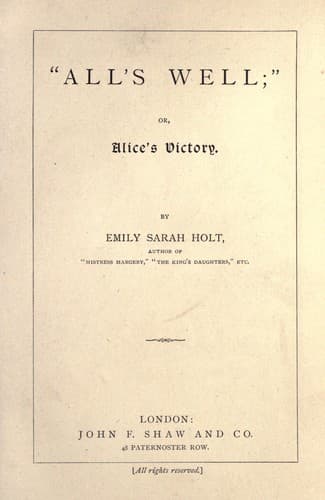
"All's Well"; or, Alice's VictoryHolt, Emily Sarah
General
"All's Well"; or, Alice's Victory
Holt, Emily Sarah
Counter-Reformation -- England -- Fiction; Historical fiction
"Two little maids, neither old enough to earn a penny, and she a
stranger in the town, pretty nigh, with never a 'quaintance saving them
near about her, and I guess very few pennies in her purse. Ay, 'tis a
sad look-out for Sens, poor heart."
"Trust me, I'll look in on her, and see what I may do, so soon as I've
borne this fardel home. Good lack! but the burying charges 'll come
heavy on her! and I doubt she's saved nought, as you say, Benedict being
sick so long."
"I scarce think there's much can be done," said Alice, as she moved
forward; "I was in there of early morrow, and Barbara Final, she took
the maids home with her. But a kindly word's not like to come amiss.
Here's Emmet [See Note 1] Wilson at hand: she'll bear you company home,
for I have ado in the town. Good-morrow, Collet."
"Well, good-morrow, Mistress Benden. I'll rest my fardel a bit on the
stile while Emmet comes up."
And, lifting her heavy bundle on the stile, Collet Pardue wiped her
heated face with one end of her mantle--there were no shawls in those
days--and waited for Emmet Wilson to come up.
Emmet was an older woman than either Alice or Collet, being nearly fifty
years of age. She too carried a bundle, though not of so formidable a
size. Both had been to Cranbrook, then the centre of the cloth-working
industry, and its home long before the days of machinery. There were
woven the solid grey broadcloths which gave to the men of the Weald the
title of "the Grey-Coats of Kent." From all the villages round about,
the factory-hands were recruited. The old factories had stood from the
days when Edward the Third and his Flemish Queen brought over the
weavers of the Netherlands to improve the English manufactures; and some
of them stand yet, turned into ancient residences for the country
squires who had large stakes in them in the old days, or peeping out
here and there in the principal streets of the town, in the form of old
gables and other antique adornments.
"Well, Collet! You've a brave fardel yonder!"
"I've six lads and two lasses, neighbour," said Collet with a laugh.
"Takes a sight o' cloth, it do, to clothe 'em."
"Be sure it do! Ay, you've a parcel of 'em. There's only my man and
Titus at our house. Wasn't that Mistress Benden that parted from you
but now? She turned off a bit afore I reached her."
"Ay, it was. She's a pleasant neighbour."
"She's better than pleasant, she's good."
"Well, I believe you speak sooth. I'd lief you could say the same of
her master. I wouldn't live with Master Benden for a power o' money."
"Well, I'd as soon wish it too, for Mistress Benden's body; but I'm not
so certain sure touching Mistress Benden's soul. 'Tis my belief if
Master Benden were less cantankerous, Mistress wouldn't be nigh so
good."
"What, you hold by the old rhyme, do you--?
"`A spaniel, a wife, and a walnut tree,
The more they be beaten, the better they be.'"
Public-domain text, read in full here on John Shaqi.
Reviews
Reviews
No reviews yet
Be the first to share your thoughts on this work.
Join the Discussion
Join the discussion
Sign in to leave a comment or review.
Sign InorCreate an account