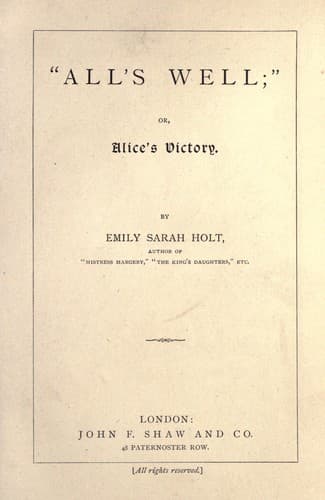
"All's Well"; or, Alice's VictoryHolt, Emily Sarah
General
"All's Well"; or, Alice's Victory
Holt, Emily Sarah
Counter-Reformation -- England -- Fiction; Historical fiction
"Good even, Mary," she added, as she came through the kitchen. "He
(without any antecedent) has promised he'll do all he can to fetch her
forth; and if he doesn't, and metely soon too, he'll wish he had, that's
all!"
So saying, Mistress Tabitha marched home to inspect her bread, and if
need were, to "set the kettle on" there also.
------------------------------------------------------------------------
Note: _E-la_ is the highest note in the musical system of Guido
d'Aretino, which was popular in the sixteenth century. "A strain beyond
E-la," therefore, signified something impossible or unreasonable.
CHAPTER SEVEN.
WHEREIN ALICE COMES HOME.
Partly moved by a faint sense of remorse, partly by Mrs Tabitha's sharp
speeches, and partly also--perhaps most of all--by his private
discomfort in respect of Mary's culinary unskilfulness, Mr Benden set
himself to eat his dose of humble pie. He waited on Mr Horden of
Finchcocks, and Mr Colepeper of Bedgebury Park, two of the chief men of
position and influence in his neighbourhood, to entreat them to exert
themselves in persuading the Bishop to release Alice as soon as
possible. The diocese, of course, was that of Cardinal Pole; but this
portion of it was at that time in the hands of his suffragan, Dr
Richard Thornton, Bishop of Dover, whom the irreverent populace
familiarly termed Dick of Dover. This right reverend gentleman was not
of the quiet and reasonable type of Mr Justice Roberts. On the
contrary, he had a keen scent for a heretic, and took great delight in
bringing one into tribulation. On receiving the letters wherein Messrs.
Horden and Colepeper interceded for Alice Benden, his Lordship ordered
the prisoner to be brought before him.
The Archbishop's gaoler went down to the prison, where Alice Benden, a
gentlewoman by birth and education, shared one large room with women of
the worst character and lowest type, some committed for slight offences,
some for heavy crimes. These women were able to recognise in an instant
that this prisoner was of a different order from themselves. Those who
were not fallen into the depths, treated her with some respect; but the
lowest either held aloof from her or jeered at her--mostly the latter.
Alice took all meekly; did what she could for the one or two that were
ailing, and the three or four who had babies with them; spoke words of
Gospel truth and kindly sympathy to such as would let her speak them:
and when sleep closed the eyes and quieted the tongues of most,
meditated and communed with God. The gaoler opened the door a little
way, and just put his head into the women's room. The prisoners might
have been thankful that there were separate chambers for men and
women... Such luxuries were unknown in many gaols at that date.
"Alice Benden!" he said gruffly.
Alice rose, gave back to its mother a baby she had been holding, and
went towards the gaoler, who stood at the top of the stone steps which
led down from the door.
Public-domain text, read in full here on John Shaqi.
Reviews
Reviews
No reviews yet
Be the first to share your thoughts on this work.
Join the Discussion
Join the discussion
Sign in to leave a comment or review.
Sign InorCreate an account