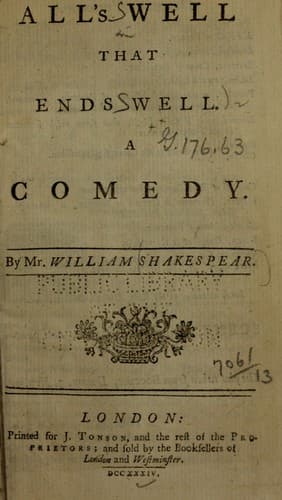
Comedy plays; Florence (Italy) -- Drama; Married women -- Drama; Runaway husbands -- Drama
COUNTESS.
I think, sir, you can eat none of this homely meat.
CLOWN.
O Lord, sir! Nay, put me to’t, I warrant you.
COUNTESS.
You were lately whipp’d, sir, as I think.
CLOWN.
O Lord, sir! Spare not me.
COUNTESS.
Do you cry ‘O Lord, sir!’ at your whipping, and ‘spare not me’? Indeed
your ‘O Lord, sir!’ is very sequent to your whipping. You would answer
very well to a whipping, if you were but bound to’t.
CLOWN.
I ne’er had worse luck in my life in my ‘O Lord, sir!’ I see things may
serve long, but not serve ever.
COUNTESS.
I play the noble housewife with the time, to entertain it so merrily
with a fool.
CLOWN.
O Lord, sir! Why, there’t serves well again.
COUNTESS.
An end, sir! To your business. Give Helen this,
And urge her to a present answer back.
Commend me to my kinsmen and my son.
This is not much.
CLOWN.
Not much commendation to them?
COUNTESS.
Not much employment for you. You understand me?
CLOWN.
Most fruitfully. I am there before my legs.
COUNTESS.
Haste you again.
[_Exeunt severally._]
SCENE III. Paris. The King’s palace.
Enter Bertram, Lafew and Parolles.
LAFEW.
They say miracles are past; and we have our philosophical persons to
make modern and familiar things supernatural and causeless. Hence is it
that we make trifles of terrors, ensconcing ourselves into seeming
knowledge when we should submit ourselves to an unknown fear.
PAROLLES.
Why, ’tis the rarest argument of wonder that hath shot out in our
latter times.
BERTRAM.
And so ’tis.
LAFEW.
To be relinquish’d of the artists,—
PAROLLES.
So I say; both of Galen and Paracelsus.
LAFEW.
Of all the learned and authentic fellows,—
PAROLLES.
Right; so I say.
LAFEW.
That gave him out incurable,—
PAROLLES.
Why, there ’tis; so say I too.
LAFEW.
Not to be helped.
PAROLLES.
Right; as ’twere a man assur’d of a—
LAFEW.
Uncertain life and sure death.
PAROLLES.
Just; you say well. So would I have said.
LAFEW.
I may truly say, it is a novelty to the world.
PAROLLES.
It is indeed; if you will have it in showing, you shall read it in what
do you call there?
LAFEW.
A showing of a heavenly effect in an earthly actor.
PAROLLES.
That’s it; I would have said the very same.
LAFEW.
Why, your dolphin is not lustier; fore me, I speak in respect—
PAROLLES.
Nay, ’tis strange, ’tis very strange; that is the brief and the tedious
of it; and he’s of a most facinerious spirit that will not acknowledge
it to be the—
LAFEW.
Very hand of heaven.
PAROLLES.
Ay, so I say.
LAFEW.
In a most weak—
PAROLLES.
And debile minister, great power, great transcendence, which should
indeed give us a further use to be made than alone the recov’ry of the
king, as to be—
LAFEW.
Generally thankful.
PAROLLES.
I would have said it; you say well. Here comes the king.
Enter King, Helena and Attendants.
LAFEW.
Lustique, as the Dutchman says. I’ll like a maid the better, whilst I
have a tooth in my head. Why, he’s able to lead her a coranto.
PAROLLES.
_Mor du vinager!_ is not this Helen?
Public-domain text, read in full here on John Shaqi.
Reviews
Reviews
No reviews yet
Be the first to share your thoughts on this work.
Join the Discussion
Join the discussion
Sign in to leave a comment or review.
Sign InorCreate an account