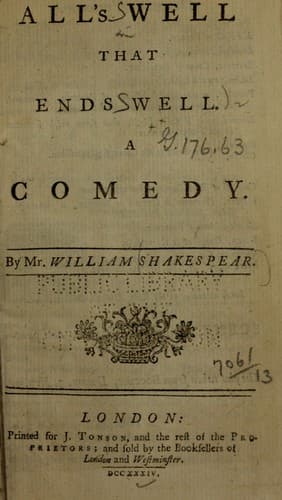
Comedy plays; Florence (Italy) -- Drama; Married women -- Drama; Runaway husbands -- Drama
COUNTESS.
This young gentlewoman had a father—O that “had!”, how sad a passage
’tis!—whose skill was almost as great as his honesty; had it stretch’d
so far, would have made nature immortal, and death should have play for
lack of work. Would for the king’s sake he were living! I think it
would be the death of the king’s disease.
LAFEW.
How called you the man you speak of, madam?
COUNTESS.
He was famous, sir, in his profession, and it was his great right to be
so: Gerard de Narbon.
LAFEW.
He was excellent indeed, madam; the king very lately spoke of him
admiringly, and mourningly; he was skilful enough to have liv’d still,
if knowledge could be set up against mortality.
BERTRAM.
What is it, my good lord, the king languishes of?
LAFEW.
A fistula, my lord.
BERTRAM.
I heard not of it before.
LAFEW.
I would it were not notorious. Was this gentlewoman the daughter of
Gerard de Narbon?
COUNTESS.
His sole child, my lord, and bequeathed to my overlooking. I have those
hopes of her good that her education promises her dispositions she
inherits, which makes fair gifts fairer; for where an unclean mind
carries virtuous qualities, there commendations go with pity, they are
virtues and traitors too. In her they are the better for their
simpleness; she derives her honesty, and achieves her goodness.
LAFEW.
Your commendations, madam, get from her tears.
COUNTESS.
’Tis the best brine a maiden can season her praise in. The remembrance
of her father never approaches her heart but the tyranny of her sorrows
takes all livelihood from her cheek. No more of this, Helena; go to, no
more, lest it be rather thought you affect a sorrow than to have.
HELENA.
I do affect a sorrow indeed, but I have it too.
LAFEW.
Moderate lamentation is the right of the dead; excessive grief the
enemy to the living.
COUNTESS.
If the living be enemy to the grief, the excess makes it soon mortal.
BERTRAM.
Madam, I desire your holy wishes.
LAFEW.
How understand we that?
COUNTESS.
Be thou blest, Bertram, and succeed thy father
In manners, as in shape! Thy blood and virtue
Contend for empire in thee, and thy goodness
Share with thy birthright! Love all, trust a few,
Do wrong to none. Be able for thine enemy
Rather in power than use; and keep thy friend
Under thy own life’s key. Be check’d for silence,
But never tax’d for speech. What heaven more will,
That thee may furnish and my prayers pluck down,
Fall on thy head! Farewell. My lord,
’Tis an unseason’d courtier; good my lord,
Advise him.
LAFEW.
He cannot want the best
That shall attend his love.
COUNTESS.
Heaven bless him! Farewell, Bertram.
[_Exit Countess._]
BERTRAM.
The best wishes that can be forg’d in your thoughts be servants to you!
[_To Helena._] Be comfortable to my mother, your mistress, and make
much of her.
LAFEW.
Farewell, pretty lady, you must hold the credit of your father.
[_Exeunt Bertram and Lafew._]
Public-domain text, read in full here on John Shaqi.
Reviews
Reviews
No reviews yet
Be the first to share your thoughts on this work.
Join the Discussion
Join the discussion
Sign in to leave a comment or review.
Sign InorCreate an account