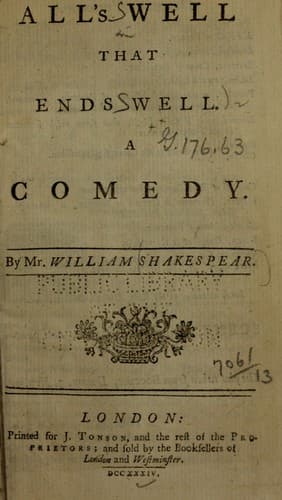
Comedy plays; Florence (Italy) -- Drama; Married women -- Drama; Runaway husbands -- Drama
HELENA.
That you may well perceive I have not wrong’d you
One of the greatest in the Christian world
Shall be my surety; fore whose throne ’tis needful,
Ere I can perfect mine intents, to kneel.
Time was I did him a desired office,
Dear almost as his life; which gratitude
Through flinty Tartar’s bosom would peep forth,
And answer thanks. I duly am inform’d
His grace is at Marseilles; to which place
We have convenient convoy. You must know
I am supposed dead. The army breaking,
My husband hies him home, where, heaven aiding,
And by the leave of my good lord the king,
We’ll be before our welcome.
WIDOW.
Gentle madam,
You never had a servant to whose trust
Your business was more welcome.
HELENA.
Nor you, mistress,
Ever a friend whose thoughts more truly labour
To recompense your love. Doubt not but heaven
Hath brought me up to be your daughter’s dower,
As it hath fated her to be my motive
And helper to a husband. But, O strange men!
That can such sweet use make of what they hate,
When saucy trusting of the cozen’d thoughts
Defiles the pitchy night; so lust doth play
With what it loathes, for that which is away.
But more of this hereafter. You, Diana,
Under my poor instructions yet must suffer
Something in my behalf.
DIANA.
Let death and honesty
Go with your impositions, I am yours
Upon your will to suffer.
HELENA.
Yet, I pray you;
But with the word the time will bring on summer,
When briers shall have leaves as well as thorns,
And be as sweet as sharp. We must away;
Our waggon is prepar’d, and time revives us.
All’s well that ends well; still the fine’s the crown.
Whate’er the course, the end is the renown.
[_Exeunt._]
SCENE V. Rossillon. A room in the Countess’s palace.
Enter Clown, Countess and Lafew.
LAFEW.
No, no, no, your son was misled with a snipt-taffeta fellow there,
whose villanous saffron would have made all the unbak’d and doughy
youth of a nation in his colour. Your daughter-in-law had been alive at
this hour, and your son here at home, more advanc’d by the king than by
that red-tail’d humble-bee I speak of.
COUNTESS.
I would I had not known him; it was the death of the most virtuous
gentlewoman that ever nature had praise for creating. If she had
partaken of my flesh and cost me the dearest groans of a mother, I
could not have owed her a more rooted love.
LAFEW.
’Twas a good lady, ’twas a good lady. We may pick a thousand salads ere
we light on such another herb.
CLOWN.
Indeed, sir, she was the sweet marjoram of the salad, or, rather, the
herb of grace.
LAFEW.
They are not herbs, you knave; they are nose-herbs.
CLOWN.
I am no great Nebuchadnezzar, sir; I have not much skill in grass.
LAFEW.
Whether dost thou profess thyself,—a knave or a fool?
CLOWN.
A fool, sir, at a woman’s service, and a knave at a man’s.
LAFEW.
Your distinction?
CLOWN.
I would cozen the man of his wife, and do his service.
LAFEW.
So you were a knave at his service indeed.
CLOWN.
And I would give his wife my bauble, sir, to do her service.
Public-domain text, read in full here on John Shaqi.
Reviews
Reviews
No reviews yet
Be the first to share your thoughts on this work.
Join the Discussion
Join the discussion
Sign in to leave a comment or review.
Sign InorCreate an account