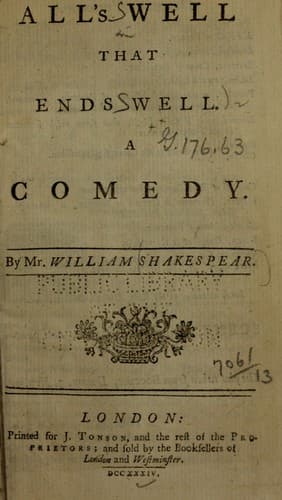
Comedy plays; Florence (Italy) -- Drama; Married women -- Drama; Runaway husbands -- Drama
CLOWN.
Truly, Fortune’s displeasure is but sluttish, if it smell so strongly
as thou speak’st of. I will henceforth eat no fish of Fortune’s
buttering. Pr’ythee, allow the wind.
PAROLLES.
Nay, you need not to stop your nose, sir. I spake but by a metaphor.
CLOWN.
Indeed, sir, if your metaphor stink, I will stop my nose, or against
any man’s metaphor. Pr’ythee, get thee further.
PAROLLES.
Pray you, sir, deliver me this paper.
CLOWN.
Foh, pr’ythee stand away. A paper from Fortune’s close-stool to give to
a nobleman! Look here he comes himself.
Enter Lafew.
Here is a pur of Fortune’s, sir, or of Fortune’s cat, but not a
musk-cat, that has fallen into the unclean fishpond of her displeasure,
and as he says, is muddied withal. Pray you, sir, use the carp as you
may, for he looks like a poor, decayed, ingenious, foolish, rascally
knave. I do pity his distress in my similes of comfort, and leave him
to your lordship.
[_Exit._]
PAROLLES.
My lord, I am a man whom Fortune hath cruelly scratch’d.
LAFEW.
And what would you have me to do? ’Tis too late to pare her nails now.
Wherein have you played the knave with Fortune that she should scratch
you, who of herself is a good lady, and would not have knaves thrive
long under her? There’s a quart d’ecu for you. Let the justices make
you and Fortune friends; I am for other business.
PAROLLES.
I beseech your honour to hear me one single word.
LAFEW.
You beg a single penny more. Come, you shall ha’t; save your word.
PAROLLES.
My name, my good lord, is Parolles.
LAFEW.
You beg more than word then. Cox my passion! Give me your hand. How
does your drum?
PAROLLES.
O my good lord, you were the first that found me.
LAFEW.
Was I, in sooth? And I was the first that lost thee.
PAROLLES.
It lies in you, my lord, to bring me in some grace, for you did bring
me out.
LAFEW.
Out upon thee, knave! dost thou put upon me at once both the office of
God and the devil? One brings thee in grace, and the other brings thee
out.
[_Trumpets sound._]
The king’s coming; I know by his trumpets. Sirrah, inquire further
after me. I had talk of you last night; though you are a fool and a
knave, you shall eat. Go to; follow.
PAROLLES.
I praise God for you.
[_Exeunt._]
SCENE III. The same. A room in the Countess’s palace.
Flourish. Enter King, Countess, Lafew, Lords, Gentlemen, Guards &c.
KING.
We lost a jewel of her, and our esteem
Was made much poorer by it; but your son,
As mad in folly, lack’d the sense to know
Her estimation home.
COUNTESS.
’Tis past, my liege,
And I beseech your majesty to make it
Natural rebellion, done i’ the blaze of youth,
When oil and fire, too strong for reason’s force,
O’erbears it and burns on.
KING.
My honour’d lady,
I have forgiven and forgotten all,
Though my revenges were high bent upon him,
And watch’d the time to shoot.
Public-domain text, read in full here on John Shaqi.
Reviews
Reviews
No reviews yet
Be the first to share your thoughts on this work.
Join the Discussion
Join the discussion
Sign in to leave a comment or review.
Sign InorCreate an account