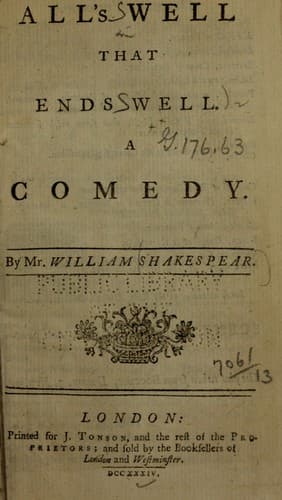
Comedy plays; Florence (Italy) -- Drama; Married women -- Drama; Runaway husbands -- Drama
CLOWN.
[_Sings._]
_ Was this fair face the cause, quoth she,
Why the Grecians sacked Troy?
Fond done, done fond,
Was this King Priam’s joy?
With that she sighed as she stood,
And gave this sentence then:
Among nine bad if one be good,
There’s yet one good in ten._
COUNTESS.
What, one good in ten? You corrupt the song, sirrah.
CLOWN.
One good woman in ten, madam, which is a purifying o’ the song. Would
God would serve the world so all the year! We’d find no fault with the
tithe-woman, if I were the parson. One in ten, quoth ’a! And we might
have a good woman born but or every blazing star, or at an earthquake,
’twould mend the lottery well; a man may draw his heart out ere he
pluck one.
COUNTESS.
You’ll be gone, sir knave, and do as I command you!
CLOWN.
That man should be at woman’s command, and yet no hurt done! Though
honesty be no puritan, yet it will do no hurt; it will wear the
surplice of humility over the black gown of a big heart. I am going,
forsooth; the business is for Helen to come hither.
[_Exit._]
COUNTESS.
Well, now.
STEWARD.
I know, madam, you love your gentlewoman entirely.
COUNTESS.
Faith I do. Her father bequeath’d her to me, and she herself, without
other advantage, may lawfully make title to as much love as she finds;
there is more owing her than is paid, and more shall be paid her than
she’ll demand.
STEWARD.
Madam, I was very late more near her than I think she wish’d me; alone
she was, and did communicate to herself her own words to her own ears;
she thought, I dare vow for her, they touch’d not any stranger sense.
Her matter was, she loved your son. Fortune, she said, was no goddess,
that had put such difference betwixt their two estates; Love no god,
that would not extend his might only where qualities were level; Diana
no queen of virgins, that would suffer her poor knight surpris’d,
without rescue in the first assault or ransom afterward. This she
deliver’d in the most bitter touch of sorrow that e’er I heard virgin
exclaim in, which I held my duty speedily to acquaint you withal;
sithence, in the loss that may happen, it concerns you something to
know it.
COUNTESS.
You have discharg’d this honestly; keep it to yourself; many
likelihoods inform’d me of this before, which hung so tottering in the
balance that I could neither believe nor misdoubt. Pray you leave me;
stall this in your bosom; and I thank you for your honest care. I will
speak with you further anon.
[_Exit Steward._]
Enter Helena.
Even so it was with me when I was young;
If ever we are nature’s, these are ours; this thorn
Doth to our rose of youth rightly belong;
Our blood to us, this to our blood is born;
It is the show and seal of nature’s truth,
Where love’s strong passion is impress’d in youth.
By our remembrances of days foregone,
Such were our faults, or then we thought them none.
Her eye is sick on’t; I observe her now.
Public-domain text, read in full here on John Shaqi.
Reviews
Reviews
No reviews yet
Be the first to share your thoughts on this work.
Join the Discussion
Join the discussion
Sign in to leave a comment or review.
Sign InorCreate an account