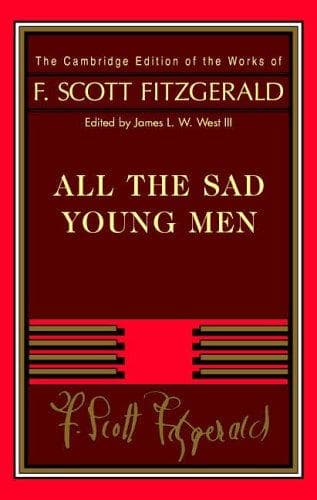
All the Sad Young MenFitzgerald, F. Scott (Francis Scott)
General
All the Sad Young Men
Fitzgerald, F. Scott (Francis Scott)
American fiction -- 20th century; Short stories, American
George O'Kelly, of Cuzco, Peru, waited an hour and a half in the hotel,
until, to be exact, the sun had reached a midway position in the sky.
Then, freshly shaven and talcum-powdered toward a somewhat more
Caucasian hue, for vanity at the last minute had overcome romance, he
engaged a taxicab and set out for the house he knew so well.
He was breathing hard--he noticed this but he told himself that it was
excitement, not emotion. He was here; she was not married--that was
enough. He was not even sure what he had to say to her. But this was the
moment of his life that he felt he could least easily have dispensed
with. There was no triumph, after all, without a girl concerned, and if
he did not lay his spoils at her feet he could at least hold them for a
passing moment before her eyes.
The house loomed up suddenly beside him, and his first thought was that
it had assumed a strange unreality. There was nothing changed--only
everything was changed. It was smaller and it seemed shabbier than
before--there was no cloud of magic hovering over its roof and issuing
from the windows of the upper floor. He rang the door-bell and an
unfamiliar colored maid appeared. Miss Jonquil would be down in a
moment. He wet his lips nervously and walked into the sitting-room--and
the feeling of unreality increased. After all, he saw, this was only a
room, and not the enchanted chamber where he had passed those poignant
hours. He sat in a chair, amazed to find it a chair, realizing that his
imagination had distorted and colored all these simple familiar things.
Then the door opened and Jonquil came into the room--and it was as
though everything in it suddenly blurred before his eyes. He had not
remembered how beautiful she was, and he felt his face grow pale and his
voice diminish to a poor sigh in his throat.
She was dressed in pale green, and a gold ribbon bound back her dark,
straight hair like a crown. The familiar velvet eyes caught his as she
came through the door, and a spasm of fright went through him at her
beauty's power of inflicting pain.
He said "Hello," and they each took a few steps forward and shook hands.
Then they sat in chairs quite far apart and gazed at each other across
the room.
"You've come back," she said, and he answered just as tritely: "I wanted
to stop in and see you as I came through."
He tried to neutralize the tremor in his voice by looking anywhere but
at her face. The obligation to speak was on him, but, unless he
immediately began to boast, it seemed that there was nothing to say.
There had never been anything casual in their previous relations--it
didn't seem possible that people in this position would talk about the
weather.
"This is ridiculous," he broke out in sudden embarrassment. "I don't
know exactly what to do. Does my being here bother you?"
"No." The answer was both reticent and impersonally sad. It depressed
him.
"Are you engaged?" he demanded.
"No."
"Are you in love with some one?"
She shook her head.
Public-domain text, read in full here on John Shaqi.
Reviews
Reviews
No reviews yet
Be the first to share your thoughts on this work.
Elsewhere in the archive
Join the Discussion
Join the discussion
Sign in to leave a comment or review.
Sign InorCreate an account