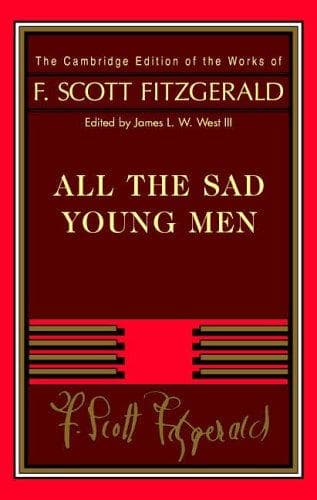
All the Sad Young MenFitzgerald, F. Scott (Francis Scott)
General
All the Sad Young Men
Fitzgerald, F. Scott (Francis Scott)
American fiction -- 20th century; Short stories, American
"Oh." He leaned back in his chair. Another subject seemed exhausted--the
interview was not taking the course he had intended.
"Jonquil," he began, this time on a softer key, "after all that's
happened between us, I wanted to come back and see you. Whatever I do in
the future I'll never love another girl as I've loved you."
This was one of the speeches he had rehearsed. On the steamer it had
seemed to have just the right note--a reference to the tenderness he
would always feel for her combined with a non-committal attitude toward
his present state of mind. Here with the past around him, beside him,
growing minute by minute more heavy on the air, it seemed theatrical and
stale.
She made no comment, sat without moving, her eyes fixed on him with an
expression that might have meant everything or nothing.
"You don't love me any more, do you?" he asked her in a level voice.
"No."
When Mrs. Cary came in a minute later, and spoke to him about his
success--there had been a half-column about him in the local paper--he
was a mixture of emotions. He knew now that he still wanted this girl,
and he knew that the past sometimes comes back--that was all. For the
rest he must be strong and watchful and he would see.
"And now," Mrs. Cary was saying, "I want you two to go and see the lady
who has the chrysanthemums. She particularly told me she wanted to see
you because she'd read about you in the paper."
They went to see the lady with the chrysanthemums. They walked along the
street, and he recognized with a sort of excitement just how her shorter
footsteps always fell in between his own. The lady turned out to be
nice, and the chrysanthemums were enormous and extraordinarily
beautiful. The lady's gardens were full of them, white and pink and
yellow, so that to be among them was a trip back into the heart of
summer. There were two gardens full, and a gate between them; when they
strolled toward the second garden the lady went first through the gate.
And then a curious thing happened. George stepped aside to let Jonquil
pass, but instead of going through she stood still and stared at him for
a minute. It was not so much the look, which was not a smile, as it was
the moment of silence. They saw each other's eyes, and both took a
short, faintly accelerated breath, and then they went on into the second
garden. That was all.
The afternoon waned. They thanked the lady and walked home slowly,
thoughtfully, side by side. Through dinner too they were silent. George
told Mr. Cary something of what had happened in South America, and
managed to let it be known that everything would be plain sailing for
him in the future.
Public-domain text, read in full here on John Shaqi.
Reviews
Reviews
No reviews yet
Be the first to share your thoughts on this work.
Elsewhere in the archive
Join the Discussion
Join the discussion
Sign in to leave a comment or review.
Sign InorCreate an account