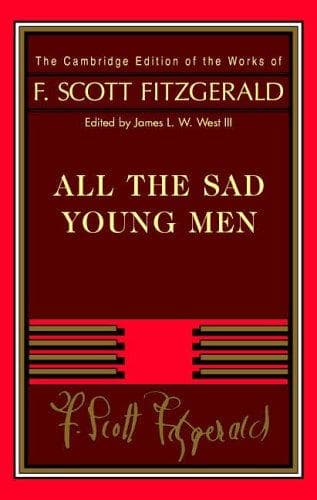
All the Sad Young MenFitzgerald, F. Scott (Francis Scott)
General
All the Sad Young Men
Fitzgerald, F. Scott (Francis Scott)
American fiction -- 20th century; Short stories, American
"If I go," he declared, "I won't come back any more."
"That's absurd, old man. You'll be back in three months with all this
depression gone. Fit as ever."
"No." He shook his head stubbornly. "If I stop, I won't go back to work.
If I stop, that means I've given up--I'm through."
"We'll take a chance on that. Stay six months if you like--we're not
afraid you'll leave us. Why, you'd be miserable if you didn't work."
They arranged his passage for him. They liked Anson--every one liked
Anson--and the change that had been coming over him cast a sort of pall
over the office. The enthusiasm that had invariably signalled up
business, the consideration toward his equals and his inferiors, the
lift of his vital presence--within the past four months his intense
nervousness had melted down these qualities into the fussy pessimism of
a man of forty. On every transaction in which he was involved he acted
as a drag and a strain.
"If I go I'll never come back," he said.
Three days before he sailed Paula Legendre Hagerty died in childbirth. I
was with him a great deal then, for we were crossing together, but for
the first time in our friendship he told me not a word of how he felt,
nor did I see the slightest sign of emotion. His chief preoccupation was
with the fact that he was thirty years old--he would turn the
conversation to the point where he could remind you of it and then fall
silent, as if he assumed that the statement would start a chain of
thought sufficient to itself. Like his partners, I was amazed at the
change in him, and I was glad when the _Paris_ moved off into the wet
space between the worlds, leaving his principality behind.
"How about a drink?" he suggested.
We walked into the bar with that defiant feeling that characterizes the
day of departure and ordered four Martinis. After one cocktail a change
came over him--he suddenly reached across and slapped my knee with the
first joviality I had seen him exhibit for months.
"Did you see that girl in the red tam?" he demanded, "the one with the
high color who had the two police dogs down to bid her good-by."
"She's pretty," I agreed.
"I looked her up in the purser's office and found out that she's alone.
I'm going down to see the steward in a few minutes. We'll have dinner
with her to-night."
After a while he left me, and within an hour he was walking up and down
the deck with her, talking to her in his strong, clear voice. Her red
tam was a bright spot of color against the steel-green sea, and from
time to time she looked up with a flashing bob of her head, and smiled
with amusement and interest, and anticipation. At dinner we had
champagne, and were very joyous--afterward Anson ran the pool with
infectious gusto, and several people who had seen me with him asked me
his name. He and the girl were talking and laughing together on a lounge
in the bar when I went to bed.
Public-domain text, read in full here on John Shaqi.
Reviews
Reviews
No reviews yet
Be the first to share your thoughts on this work.
Join the Discussion
Join the discussion
Sign in to leave a comment or review.
Sign InorCreate an account