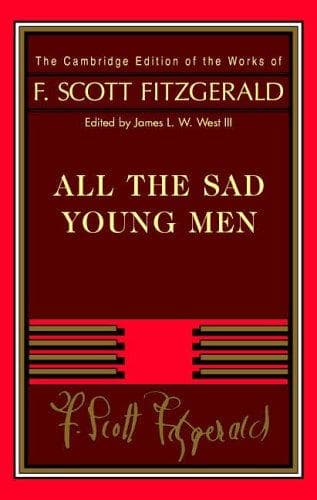
All the Sad Young MenFitzgerald, F. Scott (Francis Scott)
General
All the Sad Young Men
Fitzgerald, F. Scott (Francis Scott)
American fiction -- 20th century; Short stories, American
It began like that--and continued, with varying shades of intensity, on
such a note right up to the dénouement. Dexter surrendered a part of
himself to the most direct and unprincipled personality with which he
had ever come in contact. Whatever Judy wanted, she went after with the
full pressure of her charm. There was no divergence of method, no
jockeying for position or premeditation of effects--there was a very
little mental side to any of her affairs. She simply made men conscious
to the highest degree of her physical loveliness. Dexter had no desire
to change her. Her deficiencies were knit up with a passionate energy
that transcended and justified them.
When, as Judy's head lay against his shoulder that first night, she
whispered, "I don't know what's the matter with me. Last night I thought
I was in love with a man and to-night I think I'm in love with
you----"--it seemed to him a beautiful and romantic thing to say. It was
the exquisite excitability that for the moment he controlled and owned.
But a week later he was compelled to view this same quality in a
different light. She took him in her roadster to a picnic supper, and
after supper she disappeared, likewise in her roadster, with another
man. Dexter became enormously upset and was scarcely able to be decently
civil to the other people present. When she assured him that she had not
kissed the other man, he knew she was lying--yet he was glad that she
had taken the trouble to lie to him.
He was, as he found before the summer ended, one of a varying dozen who
circulated about her. Each of them had at one time been favored above
all others--about half of them still basked in the solace of occasional
sentimental revivals. Whenever one showed signs of dropping out through
long neglect, she granted him a brief honeyed hour, which encouraged him
to tag along for a year or so longer. Judy made these forays upon the
helpless and defeated without malice, indeed half unconscious that there
was anything mischievous in what she did.
When a new man came to town every one dropped out--dates were
automatically cancelled.
The helpless part of trying to do anything about it was that she did it
all herself. She was not a girl who could be "won" in the kinetic
sense--she was proof against cleverness, she was proof against charm; if
any of these assailed her too strongly she would immediately resolve the
affair to a physical basis, and under the magic of her physical splendor
the strong as well as the brilliant played her game and not their own.
She was entertained only by the gratification of her desires and by the
direct exercise of her own charm. Perhaps from so much youthful love, so
many youthful lovers, she had come, in self-defense, to nourish herself
wholly from within.
Public-domain text, read in full here on John Shaqi.
Reviews
Reviews
No reviews yet
Be the first to share your thoughts on this work.
Join the Discussion
Join the discussion
Sign in to leave a comment or review.
Sign InorCreate an account