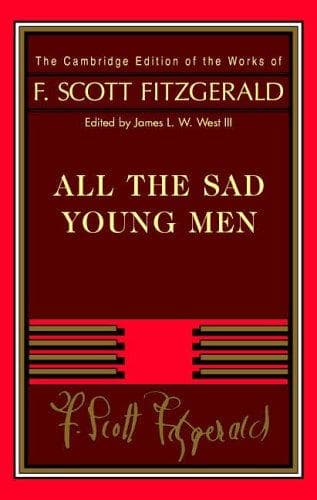
All the Sad Young MenFitzgerald, F. Scott (Francis Scott)
General
All the Sad Young Men
Fitzgerald, F. Scott (Francis Scott)
American fiction -- 20th century; Short stories, American
The beautiful little boy with eyes like blue stones, and lashes that
sprayed open from them like flower-petals had finished telling his sin
to Father Schwartz--and the square of sunshine in which he sat had moved
forward half an hour into the room. Rudolph had become less frightened
now; once eased of the story a reaction had set in. He knew that as long
as he was in the room with this priest God would not stop his heart, so
he sighed and sat quietly, waiting for the priest to speak.
Father Schwartz's cold watery eyes were fixed upon the carpet pattern on
which the sun had brought out the swastikas and the flat bloomless vines
and the pale echoes of flowers. The hall-clock ticked insistently toward
sunset, and from the ugly room and from the afternoon outside the window
arose a stiff monotony, shattered now and then by the reverberate
clapping of a far-away hammer on the dry air. The priest's nerves were
strung thin and the beads of his rosary were crawling and squirming like
snakes upon the green felt of his table top. He could not remember now
what it was he should say.
Of all the things in this lost Swede town he was most aware of this
little boy's eyes--the beautiful eyes, with lashes that left them
reluctantly and curved back as though to meet them once more.
For a moment longer the silence persisted while Rudolph waited, and the
priest struggled to remember something that was slipping farther and
farther away from him, and the clock ticked in the broken house. Then
Father Schwartz stared hard at the little boy and remarked in a peculiar
voice:
"When a lot of people get together in the best places things go
glimmering."
Rudolph started and looked quickly at Father Schwartz's face.
"I said--" began the priest, and paused, listening. "Do you hear the
hammer and the clock ticking and the bees? Well, that's no good. The
thing is to have a lot of people in the centre of the world, wherever
that happens to be. Then"--his watery eyes widened knowingly--"things go
glimmering."
"Yes, Father," agreed Rudolph, feeling a little frightened.
"What are you going to be when you grow up?"
"Well, I was going to be a baseball-player for a while," answered
Rudolph nervously, "but I don't think that's a very good ambition, so I
think I'll be an actor or a Navy officer."
Again the priest stared at him.
"I see _exactly_ what you mean," he said, with a fierce air.
Rudolph had not meant anything in particular, and at the implication
that he had, he became more uneasy.
"This man is crazy," he thought, "and I'm scared of him. He wants me to
help him out some way, and I don't want to."
"You look as if things went glimmering," cried Father Schwartz wildly.
"Did you ever go to a party?"
"Yes, Father."
Public-domain text, read in full here on John Shaqi.
Reviews
Reviews
No reviews yet
Be the first to share your thoughts on this work.
Elsewhere in the archive
Join the Discussion
Join the discussion
Sign in to leave a comment or review.
Sign InorCreate an account