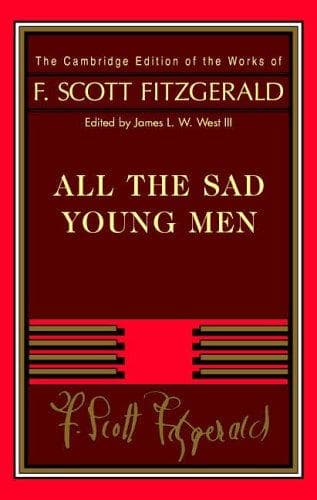
All the Sad Young MenFitzgerald, F. Scott (Francis Scott)
General
All the Sad Young Men
Fitzgerald, F. Scott (Francis Scott)
American fiction -- 20th century; Short stories, American
Then, with every opportunity given back to them, with no material
obstacle to overcome, the secret weavings of their temperaments came
between them, drying up their kisses and their tears, making their
voices less loud to one another, muffling the intimate chatter of their
hearts until the old communication was only possible by letters, from
far away. One afternoon a society reporter waited for two hours in the
Hunters' house for a confirmation of their engagement. Anson denied it;
nevertheless an early issue carried the report as a leading
paragraph--they were "constantly seen together at Southampton, Hot
Springs, and Tuxedo Park." But the serious dialogue had turned a corner
into a long-sustained quarrel, and the affair was almost played out.
Anson got drunk flagrantly and missed an engagement with her, whereupon
Paula made certain behavioristic demands. His despair was helpless
before his pride and his knowledge of himself: the engagement was
definitely broken.
"Dearest," said their letters now, "Dearest, Dearest, when I wake up in
the middle of the night and realize that after all it was not to be, I
feel that I want to die. I can't go on living any more. Perhaps when we
meet this summer we may talk things over and decide differently--we were
so excited and sad that day, and I don't feel that I can live all my
life without you. You speak of other people. Don't you know there are no
other people for me, but only you...."
But as Paula drifted here and there around the East she would sometimes
mention her gaieties to make him wonder. Anson was too acute to wonder.
When he saw a man's name in her letters he felt more sure of her and a
little disdainful--he was always superior to such things. But he still
hoped that they would some day marry.
Meanwhile he plunged vigorously into all the movement and glitter of
post-bellum New York, entering a brokerage house, joining half a dozen
clubs, dancing late, and moving in three worlds--his own world, the
world of young Yale graduates, and that section of the half-world which
rests one end on Broadway. But there was always a thorough and
infractible eight hours devoted to his work in Wall Street, where the
combination of his influential family connection, his sharp
intelligence, and his abundance of sheer physical energy brought him
almost immediately forward. He had one of those invaluable minds with
partitions in it; sometimes he appeared at his office refreshed by less
than an hour's sleep, but such occurrences were rare. So early as 1920
his income in salary and commissions exceeded twelve thousand dollars.
Public-domain text, read in full here on John Shaqi.
Reviews
Reviews
No reviews yet
Be the first to share your thoughts on this work.
Join the Discussion
Join the discussion
Sign in to leave a comment or review.
Sign InorCreate an account