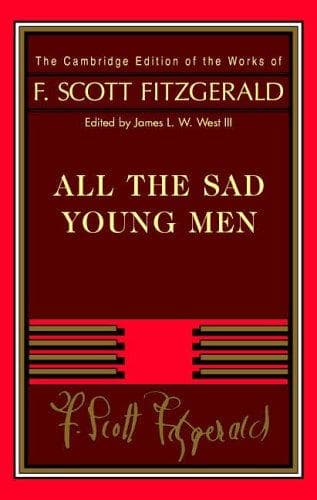
All the Sad Young MenFitzgerald, F. Scott (Francis Scott)
General
All the Sad Young Men
Fitzgerald, F. Scott (Francis Scott)
American fiction -- 20th century; Short stories, American
"Hates it. In fact, he hates about everything that I like. He's lukewarm
about the theatre, hates the opera, hates dancing, hates cocktail
parties--sometimes I think he hates everything pleasant in the world. I
sat home for a year or so. While Chuck was on the way, and while I was
nursing him, I didn't mind. But this year I told Charles frankly that I
was still young enough to want some fun. And since then we've been going
out whether he wants to or not." She paused, brooding. "I'm so sorry for
him I don't know what to do, Ede--but if we sat home, I'd just be sorry
for myself. And to tell you another true thing, I'd rather that he'd be
unhappy than me."
Luella was not so much stating a case as thinking aloud. She considered
that she was being very fair. Before her marriage men had always told
her that she was "a good sport," and she had tried to carry this fairness
into her married life. So she always saw Charley's point of view as
clearly as she saw her own.
If she had been a pioneer wife, she would probably have fought the fight
side by side with her husband. But here in New York there wasn't any
fight. They weren't struggling together to obtain a far-off peace and
leisure--she had more of either than she could use. Luella, like several
thousand other young wives in New York, honestly wanted something to do.
If she had had a little more money and a little less love, she could
have gone in for horses or for vagarious amour. Or if they had had a
little less money, her surplus energy would have been absorbed by hope
and even by effort. But the Charles Hemples were in between. They were
of that enormous American class who wander over Europe every summer,
sneering rather pathetically and wistfully at the customs and traditions
and pastimes of other countries, because they have no customs or
traditions or pastimes of their own. It is a class sprung yesterday from
fathers and mothers who might just as well have lived two hundred years
ago.
The tea-hour had turned abruptly into the before-dinner hour. Most of
the tables had emptied until the room was dotted rather than crowded
with shrill isolated voices and remote, surprising laughter--in one
corner the waiters were already covering the tables with white for
dinner.
Public-domain text, read in full here on John Shaqi.
Reviews
Reviews
No reviews yet
Be the first to share your thoughts on this work.
Elsewhere in the archive
Join the Discussion
Join the discussion
Sign in to leave a comment or review.
Sign InorCreate an account