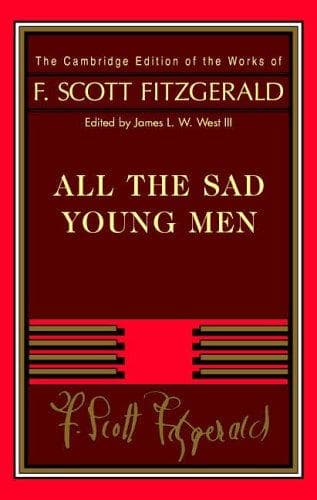
All the Sad Young MenFitzgerald, F. Scott (Francis Scott)
General
All the Sad Young Men
Fitzgerald, F. Scott (Francis Scott)
American fiction -- 20th century; Short stories, American
The evening was at seven when she turned out of the April dusk, let
herself into the hall, and saw her husband waiting in the living-room
before an open fire. She came in without a sound, closed the door
noiselessly behind her, and stood watching him for a moment through the
pleasant effective vista of the small _salon_ which intervened. Charles
Hemple was in the middle thirties, with a young serious face and
distinguished iron-gray hair which would be white in ten years more.
That and his deep-set, dark-gray eyes were his most noticeable
features--women always thought his hair was romantic; most of the time
Luella thought so too.
At this moment she found herself hating him a little, for she saw that
he had raised his hand to his face and was rubbing it nervously over his
chin and mouth. It gave him an air of unflattering abstraction, and
sometimes even obscured his words, so that she was continually saying
"What?" She had spoken about it several times, and he had apologized in
a surprised way. But obviously he didn't realize how noticeable and how
irritating it was, for he continued to do it. Things had now reached
such a precarious state that Luella dreaded speaking of such matters any
more--a certain sort of word might precipitate the imminent scene.
Luella tossed her gloves and purse abruptly on the table. Hearing the
faint sound, her husband looked out toward the hall.
"Is that you, dear?"
"Yes, dear."
She went into the living-room, and walked into his arms and kissed him
tensely. Charles Hemple responded with unusual formality, and then
turned her slowly around so that she faced across the room.
"I've brought some one home to dinner."
She saw then that they were not alone, and her first feeling was of
strong relief; the rigid expression on her face softened into a shy,
charming smile as she held out her hand.
"This is Doctor Moon--this is my wife."
A man a little older than her husband, with a round, pale, slightly
lined face, came forward to meet her.
"Good evening, Mrs. Hemple," he said. "I hope I'm not interfering with
any arrangement of yours."
"Oh, no," Luella cried quickly. "I'm delighted that you're coming to
dinner. We're quite alone."
Simultaneously she thought of her engagement to-night, and wondered if
this could be a clumsy trap of Charles' to keep her at home. If it were,
he had chosen his bait badly. This man--a tired placidity radiated from
him, from his face, from his heavy, leisurely voice, even from the
three-year-old shine of his clothes.
Nevertheless, she excused herself and went into the kitchen to see what
was planned for dinner. As usual they were trying a new pair of
servants, the luncheon had been ill-cooked and ill-served--she would let
them go to-morrow. She hoped Charles would talk to them--she hated to
get rid of servants. Sometimes they wept, and sometimes they were
insolent, but Charles had a way with him. And they were always afraid of
a man.
Public-domain text, read in full here on John Shaqi.
Reviews
Reviews
No reviews yet
Be the first to share your thoughts on this work.
Elsewhere in the archive
Join the Discussion
Join the discussion
Sign in to leave a comment or review.
Sign InorCreate an account