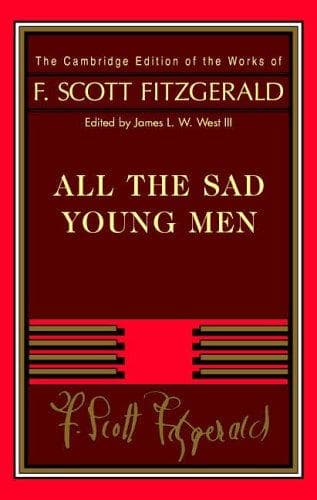
All the Sad Young MenFitzgerald, F. Scott (Francis Scott)
General
All the Sad Young Men
Fitzgerald, F. Scott (Francis Scott)
American fiction -- 20th century; Short stories, American
The nature of the curious influence that Doctor Moon exerted upon her,
Luella could not guess. But as the days passed, she found herself doing
many things that had been repugnant to her before. She stayed at home
with Charles; and when he grew better, she went out with him sometimes
to dinner, or the theatre, but only when he expressed a wish. She
visited the kitchen every day, and kept an unwilling eye on the house,
at first with a horror that it would go wrong again, then from habit.
And she felt that it was all somehow mixed up with Doctor Moon--it was
something he kept telling her about life, or almost telling her, and yet
concealing from her, as though he were afraid to have her know.
With the resumption of their normal life, she found that Charles was
less nervous. His habit of rubbing his face had left him, and if the
world seemed less gay and happy to her than it had before, she
experienced a certain peace, sometimes, that she had never known.
Then, one afternoon, Doctor Moon told her suddenly that he was going
away.
"Do you mean for good?" she demanded with a touch of panic.
"For good."
For a strange moment she wasn't sure whether she was glad or sorry.
"You don't need me any more," he said quietly. "You don't realize it,
but you've grown up."
He came over and, sitting on the couch beside her, took her hand.
Luella sat silent and tense--listening.
"We make an agreement with children that they can sit in the audience
without helping to make the play," he said, "but if they still sit in
the audience after they're grown, somebody's got to work double time for
them, so that they can enjoy the light and glitter of the world."
"But I want the light and glitter," she protested. "That's all there is
in life. There can't be anything wrong in wanting to have things warm."
"Things will still be warm."
"How?"
"Things will warm themselves from you."
Luella looked at him, startled.
"It's your turn to be the centre, to give others what was given to you
for so long. You've got to give security to young people and peace to
your husband, and a sort of charity to the old. You've got to let the
people who work for you depend on you. You've got to cover up a few more
troubles than you show, and be a little more patient than the average
person, and do a little more instead of a little less than your share.
The light and glitter of the world is in your hands."
He broke off suddenly.
"Get up," he said, "and go to that mirror and tell me what you see."
Obediently Luella got up and went close to a purchase of her honeymoon,
a Venetian pier-glass on the wall.
"I see new lines in my face here," she said, raising her finger and
placing it between her eyes, "and a few shadows at the sides that might
be--that are little wrinkles."
"Do you care?"
She turned quickly. "No," she said.
"Do you realize that Chuck is gone? That you'll never see him any more?"
Public-domain text, read in full here on John Shaqi.
Reviews
Reviews
No reviews yet
Be the first to share your thoughts on this work.
Elsewhere in the archive
Join the Discussion
Join the discussion
Sign in to leave a comment or review.
Sign InorCreate an account