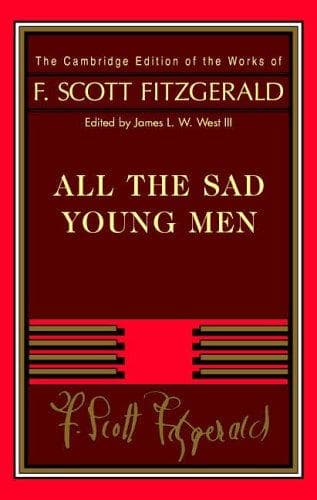
All the Sad Young MenFitzgerald, F. Scott (Francis Scott)
General
All the Sad Young Men
Fitzgerald, F. Scott (Francis Scott)
American fiction -- 20th century; Short stories, American
"Yes." She passed her hands slowly over her eyes. "But that all seems so
vague and far away."
"Vague and far away," he repeated; and then: "And are you afraid of me
now?"
"Not any longer," she said, and she added frankly, "now that you're
going away."
He moved toward the door. He seemed particularly weary to-night, as
though he could hardly move about at all.
"The household here is in your keeping," he said in a tired whisper. "If
there is any light and warmth in it, it will be your light and warmth;
if it is happy, it will be because you've made it so. Happy things may
come to you in life, but you must never go seeking them any more. It is
your turn to make the fire."
"Won't you sit down a moment longer?" Luella ventured.
"There isn't time." His voice was so low now that she could scarcely
hear the words. "But remember that whatever suffering comes to you, I
can always help you--if it is something that can be helped. I promise
nothing."
He opened the door. She must find out now what she most wanted to know,
before it was too late.
"What have you done to me?" she cried. "Why have I no sorrow left for
Chuck--for anything at all? Tell me; I almost see, yet I can't see.
Before you go--tell me who you are!"
"Who am I?--" His worn suit paused in the doorway. His round, pale face
seemed to dissolve into two faces, a dozen faces, a score, each one
different yet the same--sad, happy, tragic, indifferent, resigned--until
threescore Doctor Moons were ranged like an infinite series of
reflections, like months stretching into the vista of the past.
"Who am I?" he repeated; "I am five years." The door closed.
At six o'clock Charles Hemple came home, and as usual Luella met him in
the hall. Except that now his hair was dead white, his long illness of
two years had left no mark upon him. Luella herself was more noticeably
changed--she was a little stouter, and there were those lines around her
eyes that had come when Chuck died one evening back in 1921. But she was
still lovely, and there was a mature kindness about her face at
twenty-eight, as if suffering had touched her only reluctantly and then
hurried away.
"Ede and her husband are coming to dinner," she said. "I've got theatre
tickets, but if you're tired, I don't care whether we go or not."
"I'd like to go."
She looked at him.
"You wouldn't."
"I really would."
"We'll see how you feel after dinner."
He put his arm around her waist. Together they walked into the nursery
where the two children were waiting up to say good night.
HOT AND COLD BLOOD
Public-domain text, read in full here on John Shaqi.
Reviews
Reviews
No reviews yet
Be the first to share your thoughts on this work.
Elsewhere in the archive
Join the Discussion
Join the discussion
Sign in to leave a comment or review.
Sign InorCreate an account