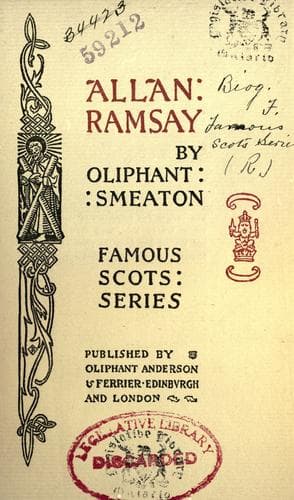
Poets, Scottish -- 18th century -- Biography; Ramsay, Allan, 1686-1758
Hitherto the sky of Ramsay's life had been well-nigh cloudless.
Misfortune and failure had never shrivelled his hopes or his enterprises
with the frost of disappointment. Nothing more serious than an envious
scribbler's splenetic effusions had ever assailed him. Now he was to
know the sting of mortification and the pinch of financial loss.
We have already adverted to the gloomy bigotry of a certain section of
the Scottish clergy of this period. To them everything that savoured of
jollity and amusement was specially inspired by the Evil One, for the
hindrance of their ministerial labours. The references to this matter
are manifold throughout Ramsay's poetry. Though no one had a deeper
respect for vital piety than he, no one more bitterly reprobated that
puritanic fanaticism that saw sin and wrong-doing in innocent recreation
and relaxation. Against Ramsay the ecclesiastical thunder had commenced
to roll some years before (according to Wodrow), when he started his
circulating library. That the works of Shakespeare, Beaumont and
Fletcher, Ben Jonson, Massinger, Dryden, Waller, and the romances of
chivalry, should be placed in the hands of the youth of Edinburgh, was
accounted a sin so grave as to merit Presbyterial censure. Accordingly,
a party, amongst whom was the infamous Lord Grange, attempted to
suppress the library. But the _ægis_ of the redoubtable Dr. Webster had
been thrown over him, and the pother in time died away. It appears,
however, that Ramsay, in 1736, had imported a large stock of
translations of the most celebrated French plays of the day, and had
added them to his library. Sufficient was this to blow into a blaze the
smouldering embers of clerical indignation. From pulpit and press our
poet was fulminated at. Not that he gave the smallest sign that he cared
one jot for all their denunciations. He attended to his shop and his
library, and quaffed his claret at the _Isle of Man Arms_, at Luckie
Dunbar's in Forrester's Wynd, or at the famous John's Coffee House, with
the cynical response that 'they might e'en gang their ain gate.'
Public-domain text, read in full here on John Shaqi.
Reviews
Reviews
No reviews yet
Be the first to share your thoughts on this work.
Elsewhere in the archive
Join the Discussion
Join the discussion
Sign in to leave a comment or review.
Sign InorCreate an account