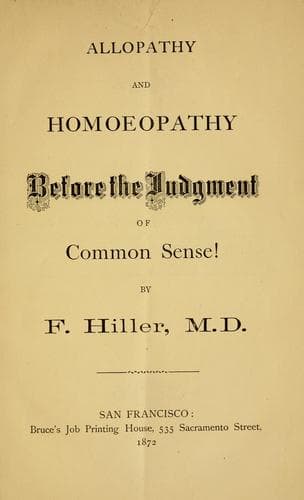
Allopathy and Homoeopathy Before the Judgment of Common Sense! — John Shaqi
Allopathy and Homoeopathy Before the Judgment of Common Sense!Hiller, Frederick
History
Allopathy and Homoeopathy Before the Judgment of Common Sense!
Hiller, Frederick
Hahnemann, Samuel, 1755-1843; Homeopathy
"It was painful for me to grope in the dark, guided only by
our books in the treatment of the sick--to prescribe according
to this or that fanciful view of the nature of diseases,
substances that only owed to mere opinion their place in the
_Materia Medica_. I had conscientious scruples about treating
unknown morbid states in my suffering fellow-creatures with
these unknown medicines; which, being powerful substances,
might, if they were not exactly suitable, (and how could the
physician know whether they were suitable or not, seeing that
their peculiar special actions were not yet elucidated?),
easily change life into death, or produce new affections
or chronic ailments, which are often much more difficult to
remove than the original disease. To become in this way a
murderer, or an aggravator of the sufferings of mankind, was
to me a fearful thought. So fearful and distressing was it,
that shortly after my marriage I abandoned the practice, and
scarcely treated any one for fear of doing him harm."
In 1789, he settled in Leipzig, and numerous writings and
translations, which have been often quoted by the best writers ever
since, came from his pen during that period. We come now to the year
1790, in which the first thought of Hom[oe]opathy issued from the
brain of the great father and founder of the new school of medicine.
It has already been hinted that Hahnemann had felt an intense desire
to obtain some clear, safe and philosophical guide to the therapeutic
action of drugs.
He was called upon to translate "Cullen's Materia Medica," and as he
progressed in the description of one medical substance after another,
he could not but feel a renewal of the earnest longing he had so
often cherished, to clear medical science from the clouds of mist and
uncertainty in which it had continued from the time of Hippocrates.
* * * * *
The workings of his mind, and the character of the man, at this time
will be best understood by a quotation from the letter he wrote to
Hufeland, where he says:
"Having briefly reviewed, the sad experience of the systems
of Sydenham and Hoffmann, of Boerhave and Glaubius, of Stahl,
Cullen and de Hean," he continues,
Public-domain text, read in full here on John Shaqi.
Reviews
Reviews
No reviews yet
Be the first to share your thoughts on this work.
Join the Discussion
Join the discussion
Sign in to leave a comment or review.
Sign InorCreate an account