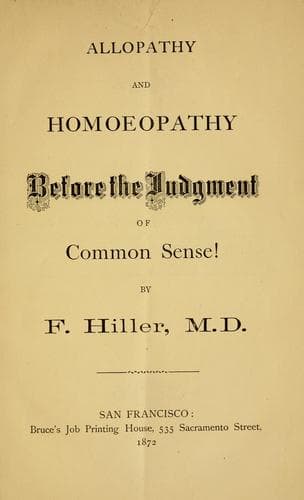
Allopathy and Homoeopathy Before the Judgment of Common Sense!Hiller, Frederick
History
Allopathy and Homoeopathy Before the Judgment of Common Sense!
Hiller, Frederick
Hahnemann, Samuel, 1755-1843; Homeopathy
Hom[oe]opathy has saved thousands of cases from surgical operations,
and has introduced safety into the lying-in-room of woman. It has been
a blessing to children, and to mothers incalculably beneficial. It
has been found equally useful in the diseases of animals, and many
veterinary institutions have been established for its practice.
Finally, it has shortened the average duration of disease, diminished
the expense of treatment enormously, economized the vital resources of
the patient, and delivered its friends from the frequently baneful and
long-lasting effects of enormous doses of medicine.
In conclusion, I will give a few statistics, from different and
reliable authorities; but first, the testimony of Dr. Routh, an
eminent Allopathic physician of London, given under circumstances
which make it significant and interesting.
In 1852, Dr. Routh published in London a book which he entitled the
"Fallacies of Hom[oe]opathy," which he says he was constrained to do,
because
"This system of medical practice has of late unfortunately
made, and continues to make, such progress in this country,
and the metropolis in particular, and is daily extending its
influence even among the most learned, and those whose high
positions in society gives them no little moral power over the
opinions of the multitude, that our profession is, I think,
bound to make it the subject of inquiry and investigation."
To that end, he collected statistics of different hospitals, to the
number of thirty-two thousand six hundred and fifty cases, treated in
hom[oe]opathic hospitals, and compared them with an equal number of
cases from old-school hospitals. He was astonished to find that the
average mortality under allopathic treatment was 10.5 per c.; while
under hom[oe]opathic treatment it was only 4.4 per c. Still he
was honest enough to publish the results. He further states that,
proportionally to the number of beds, in hom[oe]opathic hospitals
there are twice as many patients admitted and cured, as in allopathic
hospitals.
He also states that the mean duration of treatment in pneumonia was
Hom[oe]opathic, 11-2/3 days.
Allopathic, 29 days.
After visiting Vienna, Dr. Routh gives the following statistics
of cases of inflammation of the lungs, treated respectively in the
Hom[oe]opathic and Allopathic Hospitals of that city.
Allopathic mortality 23 per c.
Hom[oe]opathic mortality 5 per c.
Here, then, is allopathic testimony, the most conclusive; that, in
this fatal disease, the old system involves a mortality of 23 per c.,
while that of Hom[oe]opathy is only 5 per c.--just about one-fifth!
Public-domain text, read in full here on John Shaqi.
Reviews
Reviews
No reviews yet
Be the first to share your thoughts on this work.
Join the Discussion
Join the discussion
Sign in to leave a comment or review.
Sign InorCreate an account