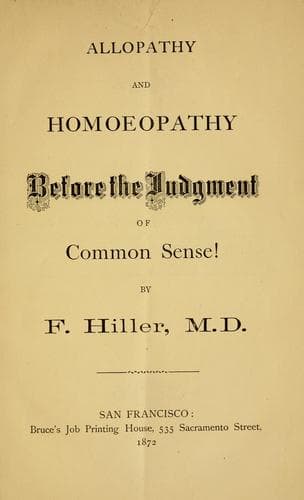
Allopathy and Homoeopathy Before the Judgment of Common Sense!Hiller, Frederick
History
Allopathy and Homoeopathy Before the Judgment of Common Sense!
Hiller, Frederick
Hahnemann, Samuel, 1755-1843; Homeopathy
Thus the year 1790 gave birth to the celebrated system of Hahnemann,
which has received from him a Greek title, expressive of its
peculiarities--Hom[oe]opathy, and in opposition to "_Contraria
Contraries Curantur_."--Allopathy.
It is not my purpose to entertain you with a detailed history of
medicine, nor even to notice the successive and conflicting theories
that have arisen from time to time; but simply to show that the
old, or Allopathic system of medicine as practiced till this day
is unworthy of our confidence; that its theory of therapeutics is
irrational and worthless; that there is an absence of any reliable
principle to guide the physicians in the treatment of diseases;
and that the sick are far better off when left to nature, than when
subject to the pernicious system of dosing, while a growing want of
confidence in this system, both in the public mind and the medical
profession, loudly calls for something more rational in its theory and
more successful in its practice.
I shall not ask you to accept my individual opinions in support of
these views, but shall place upon the witness-stand, and give you the
declarations of men who have spent their lives in the practice of this
system--most of them authors and teachers, men living in different
countries, and from the highest ranks of the profession, and who,
if any, should be able to pronounce a eulogy upon this system of
practice.
I introduce to you first BOERHAVE, a man justly illustrious in the
history of medicine, he lived a century before HAHNEMANN, and was for
over forty years Professor at the University at Leiden.
Hear him! He says:
"If we compare the good which a half dozen true disciples
of Æsculapius have done since their art began, with the
evil which the immense number of doctors have inflicted
upon mankind, we must be satisfied that it would have been
infinitely better for mankind if medical men had never
existed."
The celebrated BICHAT of Paris, thus speaks of the therapeutic system
of his day:
"It is an incoherent assemblage of incoherent opinions; it
is perhaps, of all the physiological sciences that which best
shows the caprice of the human mind. What do I say?--It is not
a science for a methodical mind; it is a shapeless assemblage
of inexact ideas, of observations often peurile, of deceptive
remedies and of formula as fastidiously and fantastically
conceived, as they are tediously arranged."
Then we find the equally celebrated French physician, MAJENDIE,
saying:
Public-domain text, read in full here on John Shaqi.
Reviews
Reviews
No reviews yet
Be the first to share your thoughts on this work.
Join the Discussion
Join the discussion
Sign in to leave a comment or review.
Sign InorCreate an account