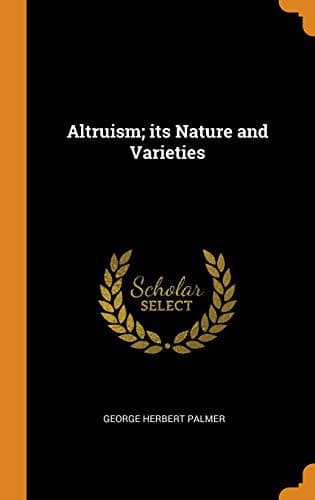
Altruism: Its Nature and VarietiesPalmer, George Herbert
Philosophy
Altruism: Its Nature and Varieties
Palmer, George Herbert
Altruism
“For love is a celestial harmony
Of likely hearts composed of stars’ consent,
Which join together in sweet sympathy
To work each other’s joy and true content,
Which they have harboured since their first descent
Out of their heavenly bowers, where they did see
And know each other here beloved to be.”
Spenser intends by “harmony” what I have meant by mutuality, something
where several different parts belong together and reach their full
significance in union. If the two hearts are similar and each merely
repeats what the other contains, there is no mutual profit. They must
fit one another, and in this fitting there is always something of the
unknown. They cannot of themselves entirely create the union. The
“stars’ consent” must be added. Heaven must shine upon them. Spenser
even suggests that their adaptation to one another is not begun in this
world, but is merely recognized here as having been ever of old. Once
known it brings them full content.
This, then, is the topic to which we now turn. It is that which the
ethical teachers of every age have counted fundamental. With Jesus
it supersedes all else. Writers as unlike as the Catholic statesman
Augustine, the Jew Spinoza, the Puritan Jonathan Edwards see in love
the fulfilment of righteousness. “Love God and do as you please,” says
Augustine. It is something we all experience and few understand. In
it there are paradoxes not found elsewhere. Delicate analysis will be
needed to bring out all that it involves, to show, too, how even here
limitations creep in. To this puzzling and attractive work I devote the
next chapter.
CHAPTER VI
LOVE
In the _Symposium of Plato_ Socrates is made to say that he can profess
knowledge of only a single subject, love, but that through acquaintance
with this he has a key to unlock all wisdom. And certainly if Socrates
understood love he deserves to be reckoned among the wise. Few have
looked into it soberly. To those who are not experiencing it, it is a
jest; to those who are, a blind passion. Novelists exploit it for cash;
poets, on the whole its most serious students, too often for graceful
fancies. Saint Paul’s compact sentences give more of its substance than
can be had in the same compass elsewhere. In undertaking an analysis
of it I believe I can best fix attention on its more important ethical
features if I ask a series of simple questions about it and then
develop their complicated answers.
Public-domain text, read in full here on John Shaqi.
Reviews
Reviews
No reviews yet
Be the first to share your thoughts on this work.
Join the Discussion
Join the discussion
Sign in to leave a comment or review.
Sign InorCreate an account